
I’ve spent months testing both the Hyperice Hypervolt 2 Pro and the Therabody Theragun Pro on my own recovery routine after hard runs, strength sessions, and long desk days.
My goal here is simple: give you a clear, real-user breakdown of how these two premium percussion massagers actually perform side by side so you can decide which one fits your body, budget, and daily needs without the marketing noise.
| Feature | Hypervolt 2 Pro | Theragun Pro (5th Gen) |
| Weight | 2.6 lbs | 2.2 lbs |
| Battery Life | Up to 180 minutes (removable) | About 120 minutes (often with dual batteries) |
| Motor Power | 90W brushless | Professional-grade with QuietForce |
| Amplitude / Stroke | Approx. 14 mm | 16 mm |
| Stall Force | Claims vary; real-world ~35–60+ lbs | 60 lbs |
| Speed Settings | 5 fixed (1,700–2,700 PPM) | Adjustable range (typically 1,750–2,400 PPM) |
| Attachments Included | 5 | 6 |
| Noise Technology | QuietGlide | QuietForce |
| Special Features | Pressure sensor with LED, Bluetooth app | Triangular multi-grip, rotating arm, app routines |
| Typical Price Range | $329–$419 | Around $530 |
| Handle Design | Pill-shaped, detachable battery | Ergonomic multi-grip with adjustable arm |
Key Differences Between The Hypervolt 2 Pro And Theragun Pro
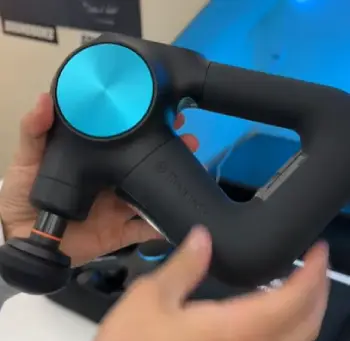
- Power delivery and depth: The Theragun Pro’s 16 mm amplitude and consistent 60-pound stall force give it an edge for deep tissue work, while the Hypervolt 2 Pro still feels effective yet can soften on the densest knots unless I ease off or change angle.
- Weight and handling: At 2.6 pounds the Hypervolt feels heavier during long sessions on my own back or legs, whereas the Theragun’s 2.2-pound frame and multi-grip design reduce fatigue when I treat hard-to-reach spots for extended periods.
- Battery system: Hypervolt’s removable single battery with three-hour runtime wins for convenience if I only need one pack, while Theragun’s dual-battery approach extends total runtime but requires managing two units during longer days.
- Noise profile: Both claim quiet operation, yet in side-by-side tests the Hypervolt stays a bit softer at comparable intensities while the Theragun’s QuietForce still impresses given its higher power output and remains usable in shared spaces.
- Ergonomics and reach: The rotating arm and triangular grip on the Theragun make self-treatment of the upper back and shoulders noticeably easier, while the Hypervolt’s pill handle stays comfortable for front-body work but proves less versatile for awkward angles.
- Attachment variety and pressure feedback: Theragun includes one extra head and the supersoft option that I reach for on tender spots, while Hypervolt counters with a useful pressure-sensor display that helps beginners avoid pressing too hard on sensitive tissue.
- Price and value positioning: Hypervolt sits lower in price, often by $100 or more, making it easier to justify for regular home use, whereas Theragun commands a premium that reflects its deeper stroke and professional-oriented design features.
Key Features Of The Hypervolt 2 Pro
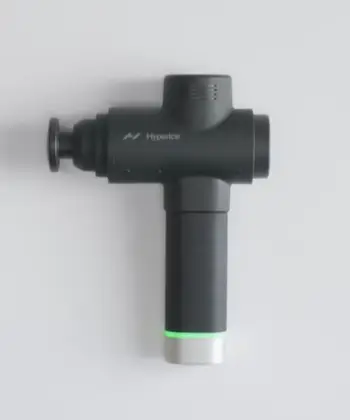
- 90-watt brushless motor: This motor delivers steady power across five speed levels and holds consistent percussion even when I press harder into larger muscle groups like quads or glutes, though it can soften a bit under extreme pressure compared with higher-stall models.
- Removable rechargeable battery: The battery pops out easily and lasts up to three hours in real use, so I keep a spare charged and never wait mid-session while the unit itself stays lightweight once the pack is attached.
- Five interchangeable heads: Fork for calves and neck, bullet for trigger points, flat for large surfaces, cushion for sensitive areas, and round for general use, with quick magnetic or snap switching that feels secure after dozens of changes.
- Digital speed dial and pressure sensor: The dial sits on the back and clicks through five precise levels from gentle 1,700 PPM up to a punchy 2,700 PPM while three LED lights show how hard I am pushing to help me avoid overdoing it on smaller muscles.
- QuietGlide technology: The motor stays noticeably quieter than many older guns so I can use it in a shared living space without drawing complaints, though at top speed it still produces a low hum that remains manageable.
- Bluetooth app integration: The Hyperice app offers guided routines for warm-up, recovery, and specific muscle groups that I follow for post-run calf work, and the timed sequences prove useful when I am too tired to plan my own session.
Solid matte finish and build: The surface resists fingerprints well and the overall construction feels durable after months of near-daily use without showing loose parts or motor strain.
Pros Of The Hypervolt 2 Pro
- Long battery life with easy swaps: Three hours of continuous use covers multiple recovery sessions and swapping the battery takes only seconds, so I never interrupt a full-body routine even on busy training days.
- Intuitive controls and pressure guidance: The digital dial and LED pressure lights make it simple to dial in the right intensity without guessing, and new users pick up the system quickly after just a couple of sessions.
- Strong quiet performance: QuietGlide keeps the sound low enough for early-morning or late-night use without disturbing others in the house, which has become one of my favorite everyday advantages.
- Solid app routines: Guided sessions help me stay consistent with recovery work, and the Bluetooth connection stays reliable while the interface remains clean and easy to follow on the phone.
- Good overall build quality: The matte finish resists fingerprints and the motor feels durable after months of near-daily use, giving me confidence that the unit will last through heavy training cycles.
- Comfortable for front-body work: The pill-shaped handle sits well in the hand when treating quads, calves, or chest, and the balance feels natural during shorter focused sessions.
Cons Of The Hypervolt 2 Pro
- Heavier feel during extended sessions: The extra weight becomes noticeable when I treat my own back for more than ten minutes, and arm fatigue sets in sooner than with lighter guns on the market.
- Stall force can drop under heavy pressure: On the densest muscle groups the percussion sometimes softens, so I have to ease off or change angle to keep the head moving smoothly through the tissue.
- Carrying case often sold separately: The base package may not include a hard case, which makes travel less convenient unless I buy the higher-priced bundle that includes storage.
- Speed dial placement: Adjusting the dial with one hand while treating certain areas can feel awkward, especially when I am already holding the unit in a tight position against my body.
- Limited reach for upper back: Without a rotating arm I sometimes struggle to hit the area between the shoulder blades comfortably, requiring more body contortion than the competing design.
Key Features Of The Theragun Pro
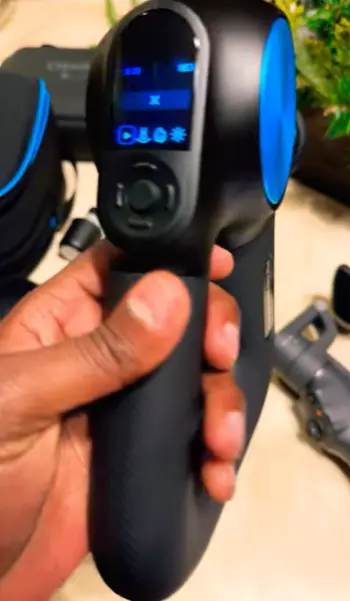
- 16 mm amplitude and 60-pound stall force: The deeper stroke reaches further into tissue and the high stall force keeps the head moving even when I lean my full body weight into stubborn knots in my upper back or IT band for more complete relief.
- QuietForce technology motor: Redesigned to cut noise while keeping power, this motor stays conversationally quiet at mid speeds and remains acceptable at full power even though it runs a bit louder than the Hypervolt under similar loads.
- Triangular multi-grip handle with rotating arm: The unique shape lets me hold the gun in several hand positions without straining my wrist while the arm rotates so I can reach my own mid-back or the back of my shoulders more easily than with a straight handle.
- Six included attachments: Standard ball, dampener, thumb, wedge, micro-point, and supersoft give me finer control for sensitive areas like the neck or broader coverage on larger muscles during longer sessions.
- Bluetooth app with guided routines: Therabody’s app includes visually guided protocols for recovery, mobility, and sleep that show exact placement and timing, especially helpful when treating areas I cannot easily see in a mirror.
- Dual-battery option and solid build: Many kits include two batteries that deliver roughly two hours each, and the overall construction feels commercial-grade so it holds up well to daily heavy use without flex or wear.
- Active torque control: This feature helps the motor adjust under changing pressure so the percussion stays smoother when I move from soft tissue to denser muscle groups mid-session.
Pros Of The Theragun Pro
- Deeper tissue reach: The 16 mm stroke and high stall force let me work through stubborn knots that other guns only skim, so post-workout recovery feels more complete after demanding sessions.
- Superior ergonomics for self-use: Multi-grip handle and rotating arm reduce wrist strain and open up hard-to-reach areas without help, which has changed how I treat my own upper body after long desk days.
- Commercial-grade durability: Built for frequent professional use, the unit handles daily heavy sessions without showing wear, loose parts, or any drop in motor performance over time.
- Extra attachment options: The supersoft and micro-point heads give finer control for sensitive or precise work, letting me tailor pressure better across different muscle groups and recovery needs.
- Strong app support and guided protocols: Clear visual routines help me target specific goals like mobility or sleep preparation, and the animations make proper placement easier when I cannot see the area I am treating.
- Consistent power under load: Even when I lean significant body weight into the device the head keeps percussing steadily, which shortens the time needed on each stubborn spot compared with softer-stall models.
Cons Of The Theragun Pro
- Higher price point: The cost sits noticeably above the Hypervolt, so for casual users the extra features may not justify the jump even though the performance difference is real on deeper tissue.
- Slightly shorter single-battery runtime: Two hours per battery is solid, yet I still need to swap or recharge more often than with the Hypervolt’s longer single pack during multi-session days.
- Noise at peak intensity: Even with QuietForce technology the top speeds produce more sound than the Hypervolt in the same conditions, which can matter in quiet shared living spaces early or late in the day.
- Bulkier profile for travel: The multi-grip design and overall shape take more space in a gym bag than a simpler cylindrical gun, making it less ideal for minimalist packing on short trips.
Learning curve for grip positions: The triangular handle offers many options, but it takes a few sessions to find the most comfortable holds for every body area without occasional awkward wrist angles.
Performance In Real Recovery Scenarios
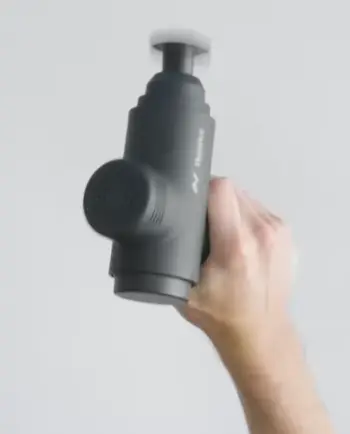
After a long trail run my calves and quads tighten first. With the Hypervolt 2 Pro I start on speed three with the cushion head and work the length of each muscle for two minutes per side.
The pressure lights help me keep consistent force. The three-hour battery means I can finish both legs, glutes, and lower back without stopping.
On denser areas like the IT band the percussion sometimes slows if I press too hard, so I lighten up or switch to the bullet head for trigger points.
Switching to the Theragun Pro for the same routine feels different. The deeper 16 mm stroke reaches further into the muscle belly.
I can lean more weight into the gun without it stalling, and the multi-grip handle lets me treat the outside of my thighs while standing without awkward wrist angles.
The rotating arm is especially useful for the upper back after desk work; I can reach the area between the shoulder blades more easily than with the Hypervolt.
At full intensity the Theragun stays powerful longer, which shortens the time I need on each stubborn spot.
Noise levels matter in a shared apartment. Both stay reasonable at mid speeds. The Hypervolt edges ahead when I use it early in the morning; the Theragun remains acceptable but produces a stronger low hum at the highest setting.
For apartment living the quieter profile of the Hypervolt is a small but real advantage.
Battery management differs in daily practice. I leave the Hypervolt battery on the charger overnight and it is ready for a full evening session.
With the Theragun I keep both batteries charged and rotate them. The dual system works well for clinic-style use or back-to-back family sessions, but for solo daily recovery the single long-life battery of the Hypervolt feels simpler.
Ergonomics And Daily Usability
Holding the Hypervolt for twenty minutes leaves my forearm more tired than the Theragun.
The pill-shaped handle is comfortable for forward-facing muscles, yet the weight distribution makes rear-body work harder.
The Theragun’s triangular grip lets me change hand positions mid-session, which reduces fatigue and improves reach.
I can treat the back of my neck while looking forward instead of twisting awkwardly.
Travel readiness also splits the two. The Hypervolt is more compact once the battery is attached, though the missing hard case in some packages is a drawback.
The Theragun’s shape is bulkier, yet the included attachments and dual batteries make it ready for longer trips or shared use.
Value And Who Each Device Suits Best?
If I prioritize quiet operation, long single-battery runtime, and a lower entry price, the Hypervolt 2 Pro delivers strong results for most recreational athletes and desk workers.
The pressure sensor is a genuine help for learning proper technique, and the app routines keep recovery structured.
If I need maximum depth, professional-level power, and easier self-treatment of the upper body, the Theragun Pro earns its higher cost.
Serious athletes, physical therapy settings, or anyone with chronic tight upper-back muscles will notice the difference in stall force and stroke length.
Neither device is essential for recovery; both are tools that speed the process and feel good. I still combine them with stretching, foam rolling, and proper sleep.
The choice comes down to how deep I need the percussion to go and how much I value ergonomics versus battery simplicity.
Also Read: Comparison Of Theragun Elite And Hypervolt 2 pro
Frequently Asked Questions (FAQ)
It depends on your needs. Theragun Pro offers deeper power and better self-reach; Hypervolt 2 Pro is quieter with longer battery life and lower cost.
Yes for most users who want solid performance, quiet operation, and a removable long-life battery without paying the highest premium.
Neither brand is universally superior. Hyperice emphasizes quiet power and battery convenience; Therabody focuses on depth, ergonomics, and professional features.
Avoid pressing directly on bones, joints, or injured areas. Start on lower intensities and never use it on the front of the neck or over the spine.
Wrapping Up
After living with both devices I can say the Hypervolt 2 Pro has become my everyday go-to for quiet, convenient recovery sessions that fit into busy weeks.
You will likely prefer the Theragun Pro if you want the deepest possible percussion and the easiest way to treat your own back and shoulders.
Test the features that matter most to your routine, weigh the price against the power you actually need, and choose the tool that will stay in your hands rather than on a shelf. Either way you will feel the difference in how your muscles recover.
Recent Posts
I tried Meltoway Hair Dissolving Cream because I wanted a quick way to deal with unwanted body hair without reaching for a razor every few days. If you are looking for a convenient at-home...
If you’re considering a saffron-based supplement to support mood, appetite control, and everyday wellness, Happy Saffron Plus is worth considering.I like that it takes a familiar botanical...