
I set out to compare the Cala and Rheem ProTerra heat pump water heaters because I wanted a clear, practical sense of which one better fits real homes that care about efficiency, hot water reliability, and long-term costs.
Both move heat from the surrounding air into the tank instead of generating it with resistance elements alone, yet they take very different approaches to when and how they heat.
This piece walks through the features, real-world behavior, and trade-offs so you can decide which system aligns with your household patterns and energy setup.
| Feature | Cala (65-gal model) | Rheem ProTerra (typical 50-65 gal) |
| Tank capacity | 65 gallons nominal | 40 / 50 / 65 / 80 gallons |
| UEF | 3.76 | Up to 3.88–4.07 depending on model |
| First-hour rating | 78 gallons | 67–76+ gallons |
| Compressor | Variable speed | Fixed or hybrid modes |
| Key intelligence | Predictive learning of household patterns, solar/TOU coordination | Manual modes (Energy Saver, Heat Pump, High Demand, Electric, Vacation) |
| Mixing valve | Integrated | Available on some models / HydroBoost on plug-in versions |
| Ambient range | 37–120 °F | 37–145 °F |
| Leak protection | Integrated | LeakGuard with auto shut-off on many models |
| Connectivity | App with usage data, remote diagnostics | EcoNet Wi-Fi app |
| Typical unit price | Around $2,999 before rebates | $1,500–$2,600 range before rebates |
| Warranty | 10 years tank/parts, up to 3 years labor with pro install | 10-year limited tank and parts |
Key Differences Between The Cala And Rheem Heat Pump Water Heater
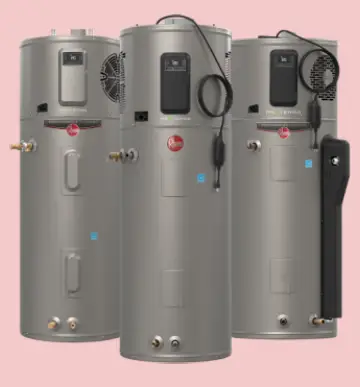
- Predictive planning versus selectable modes: Cala spends its first month mapping your actual use and then schedules heating around that map plus external signals such as time-of-use rates or solar production.
Rheem leaves the mode choice to you or to a simple schedule you set in the app. The former removes daily decisions while the latter keeps control in your hands.
- Variable-speed compressor versus mode-based recovery: Cala’s compressor can modulate its speed so it runs quietly and efficiently when demand is low and accelerates when the system knows a busy period is approaching. Rheem relies on mode selection and the backup elements to handle recovery speed.
In practice this means Cala stays in pure heat-pump operation more of the time.
- Integrated mixing valve and higher storage temperature: Cala stores water hotter and mixes it down at the outlet.
That design effectively increases first-hour delivery without a larger physical tank. Rheem offers mixing on some configurations but it is not the core of the control strategy.
- Grid and solar awareness: Cala can shift heating to periods of high solar production or low electricity rates without constant user input.
Rheem’s EcoNet supports scheduling and demand-response ports on many models yet the intelligence stays more reactive.
- Ambient temperature tolerance: Rheem’s published range extends higher which can matter in very warm mechanical rooms or garages that exceed 120 °F.
Cala’s range is still broad enough for most conditioned or semi-conditioned spaces.
- Availability and service network: Rheem is widely stocked through big-box stores and contractors so parts and trained technicians are easier to find in most markets.
Cala is newer and ships direct or through its pro network while it is still building its installed base.
Key Features Of Cala
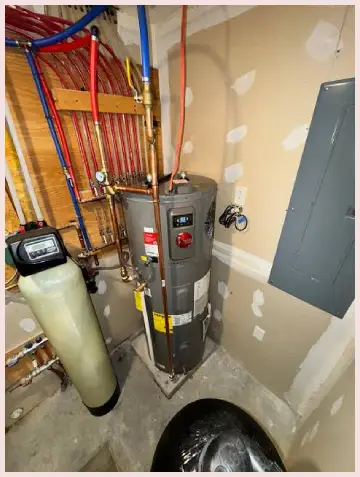
- Predictive Intelligence that learns household patterns: After the initial learning period the system anticipates when you will need hot water and prepares the tank in advance.
That reduces the need for resistance elements.
- Variable-speed compressor: The compressor adjusts its output rather than simply turning on or off.
Slow operation improves efficiency while faster operation covers high-demand windows.
- Integrated flow sensor: Real-time draw data feeds the predictive model so the system knows both how much water left the tank and when the next draw is likely.
- Integrated mixing valve: Water can be stored above the setpoint and blended to a safe delivery temperature.
This increases effective capacity during peak periods.
- Solar and time-of-use coordination: The system can prioritize free or cheap electricity when those signals are available.
- App with live and historical usage data: You can see patterns enable boost mode for guests and receive remote diagnostics.
Lower reliance on resistance elements: Field data from the manufacturer’s fleet shows resistance input dropping to single-digit percentages once the predictive system is active.
Pros Of Cala
- Higher real-world heat-pump utilization: Because the system plans ahead it spends far less time on resistance elements than a typical hybrid unit that reacts after the tank cools.
- More usable hot water during busy periods: The combination of higher storage temperature and mixing delivers greater effective capacity from the same physical tank size.
- Hands-off efficiency: Once the learning period ends most owners leave the system alone. It continues to adapt to changes in household patterns.
- Strong solar and rate optimization: Homes with rooftop solar or steep time-of-use differentials see additional savings that pure mode-based systems capture less consistently.
- Quiet variable-speed operation: The compressor can run at lower speeds for long periods which reduces noise compared with fixed-speed units that cycle more abruptly.
Cons Of Cala
- Higher upfront equipment cost: The unit price sits at the premium end of the heat-pump category before rebates.
- Limited size options at launch: The primary offering is a 65-gallon tank. Households that need smaller or larger capacities have fewer choices.
- Newer brand and thinner service network: Finding a local technician familiar with the product can take more effort than with established manufacturers.
- Learning period required: The first month operates with less intelligence while the system gathers data. Performance improves after that window.
- Ambient range stops at 120 °F: Very hot mechanical rooms may push the unit outside its preferred operating window more often than a Rheem.
Key Features Of Rheem ProTerra
- Multiple discrete operating modes: You can lock the unit into Heat Pump only switch to High Demand before company arrives or drop into Vacation mode when the house is empty.
- Wide ambient operating range: The compressor continues working down to 37 °F and up to 145 °F on many models which keeps efficiency high in cold garages and warm mechanical rooms.
- LeakGuard on many configurations: A sensor and automatic shut-off valve limit water damage if a leak develops.
- EcoNet connectivity: Temperature control scheduling energy monitoring and demand-response readiness are available through the app and on some units a physical port.
- Choice of tank sizes and voltage options: 40- through 80-gallon tanks and both 120 V plug-in and 240 V hard-wired versions expand installation possibilities.
- Established service ecosystem: Parts manuals and technicians are widely available which simplifies long-term ownership.
Pros Of Rheem ProTerra
- Broad size and configuration range: You can match tank capacity more precisely to household size and choose 120 V plug-in models that avoid panel upgrades in many cases.
- Familiar contractor ecosystem: Most plumbers and HVAC technicians already know the product line which usually lowers installation risk and speeds service calls.
- Strong published efficiency numbers: UEF ratings reach the high 3s and low 4s on certain models and the wide ambient range keeps the compressor active longer in marginal conditions.
- Leak protection and proven hardware: LeakGuard and the overall mechanical design have years of field data behind them.
- Flexible manual control: If you prefer to decide the operating mode yourself or schedule specific periods of high demand the controls support that directly.
Cons Of Rheem ProTerra
- Greater reliance on resistance elements in real use: Studies of conventional heat-pump water heaters show a meaningful fraction of annual energy still comes from the backup elements especially when the tank is allowed to deplete before reheating begins.
- Mode selection can feel like homework: The “Energy Saver” setting does not always deliver the lowest energy use in practice and some owners report higher consumption in that mode than in pure Heat Pump mode.
- Recovery speed depends on mode choice: In the most efficient settings recovery is slower so households with simultaneous showers and laundry may need to switch modes or size up the tank.
- App and mode prompts can feel intrusive: Some users describe constant reminders to change modes that do not always improve results.
- Mixing valve is not standard on every model: Without it the tank cannot store excess thermal energy as effectively as a system designed around higher storage temperatures.
Real-World Efficiency And Hot-Water Delivery?
I look at efficiency two ways: the laboratory UEF number and the share of heating that actually comes from the heat pump rather than resistance elements.
Laboratory numbers for both products sit in the same general range. Real homes diverge.
Cala’s predictive approach keeps resistance input low after the learning period. The system preheats before expected draws and can coast when no demand is forecast.
That behavior reduces the moments when the tank temperature falls far enough to trigger the elements. Owners who also feed the system solar production or time-of-use price signals gain another layer of savings.
Rheem’s efficiency depends heavily on the mode you leave it in and how aggressively the household draws hot water.
In pure Heat Pump mode the compressor does most of the work but recovery slows. In High Demand or Energy Saver modes the elements share the load and energy use rises.
The wider ambient range helps the compressor stay online in colder spaces which is a genuine advantage in unheated garages in northern climates.
For consistent hot water during high-demand periods the mixing-valve strategy on Cala gives it an edge. Storing hotter water and blending at the outlet stretches the first-hour delivery.
Rheem can match or exceed that volume by moving to a larger tank or by switching into High Demand mode ahead of time but those steps require either extra capital or user attention.
Upfront Cost, Operating Cost, And Payback
Equipment pricing favors Rheem in most markets. A 50- or 65-gallon ProTerra often lands several hundred dollars below the Cala 65-gallon unit before any incentives.
Installation costs are similar if the electrical and condensate requirements are already met. Both need a 240 V circuit on most models and a drain for condensate.
Operating costs reverse the picture in many cases. Any heat-pump water heater cuts energy use dramatically compared with a standard electric tank.
The further reduction from predictive control and lower resistance use can add meaningful dollars per year especially where electricity rates are high or where solar is present. Homes on steep time-of-use tariffs see the largest additional benefit from Cala’s ability to shift load automatically.
Rebates and tax credits apply to both. Federal and utility incentives for heat-pump water heaters can narrow or eliminate the equipment price gap so the net installed cost should be calculated with local programs in mind rather than list price alone.
Installation And Day-To-Day Ownership
Both units need space for air movement. A tight closet without louvers or ducting forces either unit into resistance mode and erases most of the efficiency advantage.
Condensate must go somewhere. A floor drain or condensate pump is required. Noise levels are comparable to a refrigerator for both though Cala’s variable-speed compressor can stay quieter during low-load periods.
Cala’s app focuses on transparency with usage graphs predicted heating windows and boost controls. Rheem’s EcoNet emphasizes mode selection and scheduling.
Owners who like to set a schedule and forget it will be comfortable with either. Owners who want the system to keep adapting without further input will prefer Cala’s approach.
Service experience differs. Rheem parts and technicians are common. Cala relies on its growing pro network and remote diagnostics. Early remote monitoring of new installs is part of the company’s process.
Warranty length is similar on the tank and parts side. Labor coverage is stronger on Cala when installed by a registered pro.
Frequently Asked Questions (FAQ)
Cala learns usage patterns and plans heating ahead keeping resistance use low. Rheem relies on the mode you select. Efficiency varies more with household behavior and mode choice.
Cala’s higher storage temperature plus mixing valve generally provides more usable volume from a similar tank size. Rheem can match it by selecting High Demand mode or using a larger tank.
Rheem usually costs less to buy. Cala often costs less to run over time especially with solar or time-of-use rates so payback depends on your electricity prices and incentives.
Cala does this automatically once configured. Rheem can do it through schedules and demand-response features but needs more manual setup.
Final Thoughts
I wrote this comparison because the choice between these two heat pump water heaters is less about laboratory ratings and more about how each system behaves inside an actual home.
Cala treats the tank as an intelligent thermal battery that learns plans and coordinates with the rest of your energy system.
Rheem gives you a proven widely supported hybrid unit with flexible modes and strong ambient performance. If you value hands-off efficiency solar coordination and maximum usable hot water from a given tank size Cala is the stronger match.
If you want lower equipment cost broad size options and a service network that already exists in almost every market Rheem ProTerra remains a solid practical choice.
Look at your electricity rates whether you have solar how simultaneous your hot-water draws are and how much you want to interact with the controls.
Those factors will point you toward the system that will actually deliver the savings and comfort you expect.
Recent Posts
Arhaus Kipton Sofa Review: Is This Expensive Couch Worth Buying?
The Arhaus Kipton sofa looks luxurious, offers customizable designs, and features an inviting silhouette.However, its premium price and concerning customer feedback make me hesitant to recommend...
Nolan Interior sofa covers promise an easy way to refresh your furniture, protect upholstery, and improve your living room without buying a new sofa.However, customer dissatisfaction and negative...