
LabCharge Ionic Air Purifier promises cleaner indoor air without expensive replacement filters, but its disappointing customer feedback, questionable performance claims, and lack of independently verified cleaning results make me hesitant to recommend it.
Although its compact design and filter-free operation sound appealing, I believe buyers should consider established HEPA air purifiers instead.
In this review, I’ll examine its technology, customer experiences, potential drawbacks, maintenance requirements, and alternatives before deciding whether LabCharge deserves your money.
My First Experience Of The LabCharge Ionic Air Purifier
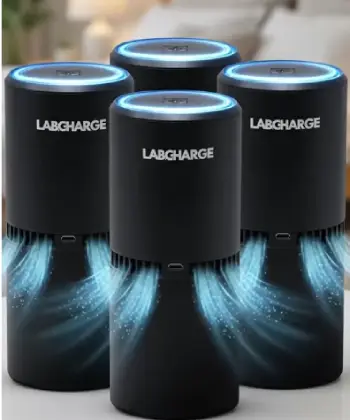
When I evaluate an air purifier, I don’t focus only on its appearance or the promises printed on its packaging.
I want to know whether it can genuinely improve indoor air quality, whether it performs consistently, and whether customers receive reasonable value for their money.
These are particularly important considerations with the LabCharge Ionic Air Purifier because its marketing emphasizes convenience and filter-free technology, while customer feedback raises questions about reliability and effectiveness.
To be transparent, this is an evidence-based product assessment, not a claim that I personally purchased or laboratory-tested the device.
I’m evaluating its advertised specifications, available customer feedback, and the established science behind ionic air purification.
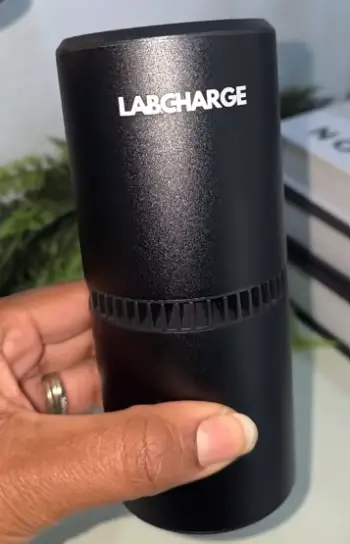
The first thing that caught my attention was its compact design. LabCharge describes its standard ionic purifier as approximately seven inches tall and three inches wide.
It uses a USB power connection, making it relatively easy to position on a desk, bedside table, or another convenient surface. Unlike traditional air purifiers, it doesn’t require regular HEPA filter replacements.
That sounds attractive, especially if you’ve previously spent money replacing filters every few months. However, I don’t think the absence of a replacement filter automatically makes an air purifier more economical or effective.
According to the manufacturer’s product information, the device is designed to release negative ions that charge airborne particles.
These particles are then expected to cluster together or settle onto nearby surfaces instead of remaining suspended in the air. The company advertises coverage of up to 250 square feet for the standard model.
My concern is that particle settling isn’t necessarily the same as removing pollutants from your indoor environment.
Imagine using an air purifier in your bedroom. If airborne dust particles become charged and settle onto your furniture, you might notice less dust floating around temporarily.
However, those particles haven’t necessarily disappeared. They may remain on your bedding, floor, curtains, or desk and become airborne again when someone moves around the room.
That’s an important distinction that I would want every potential buyer to understand.
Another issue is the absence of a conventional mechanical filtration system. A genuine HEPA air purifier pulls room air through a physical filter that captures particles.
LabCharge’s standard ionic model uses a different approach, so I wouldn’t automatically compare its performance with that of a certified HEPA filtration system.
Also Read: Is Lunino Air Purifier Worth It?
Pros Of The LabCharge Ionic Air Purifier
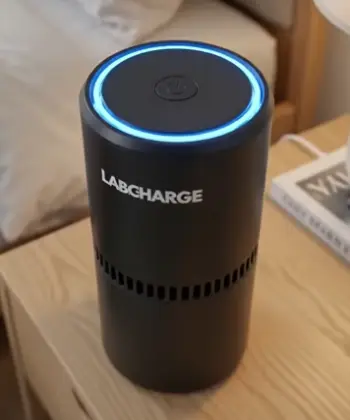
- Compact and Space-Saving Design
One advantage is its relatively small footprint.
Many traditional air purifiers are large enough to require dedicated floor space. This can be inconvenient in smaller bedrooms, apartments, offices, and dormitories.
LabCharge’s compact design makes it easier to position on a desk, shelf, or bedside table.
I appreciate products that don’t unnecessarily complicate everyday living. However, I would still prioritize cleaning performance over appearance.
- No Routine HEPA Filter Replacement
The filter-free design can appeal to people who dislike purchasing replacement filters.
Depending on the purifier, replacement filters can represent a meaningful recurring expense. Some models also require multiple filter types, such as a pre-filter, HEPA filter, and activated carbon filter.
LabCharge avoids that particular expense.
However, the absence of replacement filters shouldn’t be confused with maintenance-free operation. The device still requires appropriate cleaning and inspection.
- Simple USB-Powered Operation
Another positive feature is its straightforward power arrangement.
A USB-powered appliance can be convenient for a home office, bedside table, or compact workspace.
You don’t need to learn complicated settings or manage an elaborate installation process.
This simplicity may appeal to people who prefer basic appliances.
- Quiet Operation Is a Potential Advantage
Noise is an important consideration when purchasing an air purifier.
If you’re using a device in a bedroom, loud fans can interfere with sleep. Similarly, excessive noise can become distracting in an office.
An ionic device without a conventional high-speed filtration fan may operate quietly.
However, I wouldn’t assume every LabCharge unit remains silent throughout its lifespan. Customer complaints mentioning buzzing and whining noises make long-term reliability an important consideration.
- No Complicated Filter Installation
Traditional purifiers sometimes require users to remove protective packaging, install filters, and understand replacement indicators.
LabCharge’s standard design is comparatively simple.
This could make initial setup easier for someone who isn’t comfortable handling household appliances.
Nevertheless, easy installation doesn’t establish cleaning effectiveness.
Cons Of The LabCharge Ionic Air Purifier
- Uncertain Real-World Cleaning Performance
My biggest concern is the lack of convincing, independently verified performance information.
The manufacturer advertises room coverage, but a coverage claim isn’t equivalent to an independently tested CADR rating.
CADR measures how much cleaned air an air purifier delivers for specific pollutants, including smoke, dust, and pollen.
Without a verified measurement, buyers have limited information about how quickly LabCharge can meaningfully reduce airborne particle concentrations.
- No Conventional HEPA Filtration
The standard ionic model doesn’t provide the same physical filtration mechanism as a HEPA air purifier.
This matters if you’re purchasing an appliance specifically to capture allergens, dust, smoke particles, and other airborne contaminants.
I would rather select a purifier with a clearly identified filtration system and independently supported performance data.
- Negative Customer Feedback
Customer complaints are another major disadvantage.
Some buyers report that their devices stop working, become noisy, or fail to deliver noticeable improvements.
Others describe frustrating experiences involving returns, replacements, and customer support.
I don’t consider every negative review proof of a defective product. However, repeated complaints about similar problems make me cautious.
- Questions About Long-Term Durability
A product should provide consistent performance beyond the first few weeks.
Some customer complaints describe units developing mechanical noises or malfunctioning after relatively short periods.
This is particularly concerning when someone purchases multiple devices for different rooms.
I would want stronger evidence of product longevity before recommending LabCharge.
- Ozone-Emission Concerns
This is a particularly important issue with ionic air cleaners.
Some electronic air-cleaning devices can produce ozone as a by-product. Ozone is a respiratory irritant, and exposure can cause problems for sensitive individuals.
LabCharge states that an independent laboratory measured ozone emissions at 0.05 parts per million.
However, I wouldn’t interpret that figure as proof of zero ozone emissions or automatically treat it as evidence that the product is appropriate for every indoor environment.
The manufacturer’s own website also states that the product isn’t CARB-certified and doesn’t meet California’s electrical safety and ozone-emission requirements.
That disclosure deserves attention.
The Environmental Protection Agency recommends looking for UL 2998 certification when considering devices that use bipolar ionization, because this standard addresses zero-ozone emissions.
- Unclear Value for Money
I don’t think the product’s filter-free design is enough to justify its purchase.
When comparing air purifiers, I consider how much clean air they deliver, their expected lifespan, and whether their performance has been independently evaluated.
LabCharge’s current evidence doesn’t give me sufficient confidence to recommend it over established filtration products.
Maintenance For The LabCharge Ionic Air Purifier
Also Read: Is Austin Air HealthMate Plus Air Purifier Worth It?
- Clean the Exterior Regularly
Dust can accumulate on small electronic appliances, especially when they’re placed on desks, shelves, and bedside tables.
I would gently wipe the exterior with a clean, dry microfiber cloth.
Before cleaning, disconnect the USB power connection.
Avoid spraying water or household cleaning chemicals directly onto the unit because moisture can enter the electrical components.
Regular exterior cleaning helps prevent dust accumulation and keeps the device looking presentable.
- Keep Airflow Areas Clear
If your particular model has openings or vents, make sure they aren’t blocked by curtains, furniture, papers, or other objects.
Blocked openings can interfere with the intended operation of electronic appliances.
I would also avoid positioning the device in a tightly enclosed space.
- Follow the Manufacturer’s Cleaning Instructions
Different ionic devices have different internal designs.
Some have accessible collection surfaces, while others rely on a different arrangement.
I wouldn’t disassemble LabCharge or attempt to clean internal electrical components without explicit manufacturer instructions.
Improper handling can damage the appliance or create an electrical safety concern.
- Use a Suitable USB Power Source
The standard LabCharge model is advertised as USB-powered and designed for a 5V connection.
I would use a suitable, reliable adapter and inspect the cable periodically.
If the cable becomes damaged, loose, or unusually warm, discontinue use until the problem has been addressed.
Avoid using questionable power adapters simply because they fit the connection.
- Inspect the Device for Unusual Noises
This is especially relevant given customer complaints involving buzzing and whining sounds.
A purifier that suddenly becomes noisy may have developed an internal problem.
I wouldn’t ignore unusual sounds or assume that they are normal.
Disconnect the unit if you notice burning smells, excessive heat, damaged wiring, or other signs of electrical malfunction.
Contact the manufacturer or retailer for assistance rather than attempting an improvised repair.
- Monitor Your Indoor Air Quality Separately
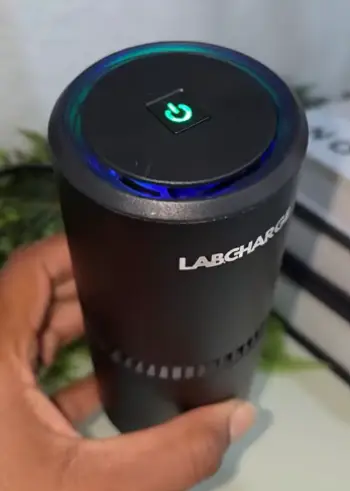
One mistake I would avoid is assuming that a glowing indicator light proves that the device has successfully cleaned the air.
A status indicator is not automatically equivalent to an independently calibrated particle measurement.
If you’re concerned about indoor pollution, consider an appropriate air-quality monitor and pay attention to ventilation, smoke sources, and dust accumulation.
You should also remember that monitoring devices have limitations and don’t measure every possible pollutant.
Comparison Of Labcharge Ionic Air Purifier Other Air Purifier Brands
- LabCharge vs. Levoit Air Purifiers
LabCharge Ionic Air Purifier and Levoit Core 300S
Levoit is one of the alternatives I would investigate before buying LabCharge.
The Levoit Core series uses mechanical filtration, with models such as the Core 300S incorporating a HEPA-grade filtration system and activated carbon filtration.
This gives buyers a more conventional approach to capturing airborne particles and addressing certain odors.
LabCharge, on the other hand, relies on negative-ion technology rather than conventional mechanical filtration.
I prefer the Levoit approach because I can evaluate its filter specifications, replacement requirements, and published cleaning performance.
Levoit filters require periodic replacement, which creates an ongoing expense. However, I consider that a reasonable trade-off when the purifier provides measurable filtration performance.
- LabCharge vs. Winix Air Purifiers
LabCharge and Winix 5500-2
Winix is another brand I would consider.
The Winix 5500-2 uses a multi-stage filtration arrangement that includes a washable pre-filter, an activated carbon filter, and a True HEPA filter.
It also offers a more established filtration approach for managing household particles.
Some Winix models include an optional PlasmaWave feature. I would review the relevant model’s emissions information and operating instructions rather than assuming every electronic air-cleaning feature is necessary.
Compared with LabCharge, Winix offers a more substantial filtration system and independently verified CADR information for relevant models.
The main disadvantage is that replacement filters create additional expenses.
However, I would rather budget for replacement filters than purchase a product whose real-world cleaning capacity remains unclear.
- LabCharge vs. Honeywell Air Purifiers
LabCharge and Honeywell HPA300
Honeywell has a longer-established presence in the air purification category.
Models such as the Honeywell HPA300 are designed around mechanical particle filtration.
I particularly like the idea of choosing a purifier based on its documented cleaning capacity rather than relying on broad statements about negative ions.
Honeywell units are generally larger than LabCharge, so they may not be suitable for every desk or bedside table.
They also require filter maintenance.
However, if I were purchasing an air purifier for a larger living room or bedroom, I would give a properly sized Honeywell model serious consideration.
- LabCharge vs. Blueair Air Purifiers
LabCharge and Blueair Blue Pure 311i Max
Blueair is another alternative worth researching.
Blueair uses mechanical filtration technology, with certain models combining particle filtration and activated carbon.
I like that buyers can compare different models based on room coverage, filtration specifications, and published performance information.
Blueair products can cost more than small ionic devices, and replacement filters should be included in the long-term budget.
Nevertheless, I consider a properly selected mechanical filtration system a more dependable starting point for someone seeking measurable improvements in indoor air quality.
Is LabCharge Ionic Air Purifier Worth Buying?
After examining its advertised features, ionic technology, and customer feedback, I wouldn’t recommend LabCharge as my primary air-cleaning solution.
The product has some attractive characteristics. It’s compact, USB-powered, and doesn’t require conventional replacement filters.
However, I don’t believe those features compensate for the questions surrounding its cleaning performance and long-term reliability.
The biggest issue is the difference between what an ionic device may theoretically do and what it can demonstrate in an actual home.
If I’m spending money on an appliance intended to improve the air I breathe, I want independent performance measurements and clear safety documentation.
I also want a product supported by dependable customer service.
LabCharge doesn’t currently give me enough confidence on those points.
Also Read: Is Holmes Air Purifier Worth It?
Frequently Asked Questions (FAQ)
Yes, ionic air purifiers can influence airborne particles by giving them an electrical charge. Some particles may then collect on surfaces or collection plates.
However, effectiveness varies considerably between devices. Ionizers aren’t equivalent to HEPA filtration, and they generally don’t remove gases and odors effectively. Some can also generate ozone.
For dependable particle removal, I would choose a properly sized mechanical HEPA air purifier with independently verified performance.
LabCharge is an identifiable commercial brand with an official product website, published specifications, and customer-review profiles. That doesn’t automatically establish that its product performs as advertised.
Customer feedback is mixed, with complaints involving product failures, delivery, refunds, and disappointing cleaning results.
I wouldn’t label the business fraudulent based solely on negative reviews. However, I would approach the purchase cautiously and carefully examine the warranty and return conditions.
I couldn’t establish that LabCharge has received an independent Consumer Reports product evaluation.
It’s important to distinguish between manufacturer advertisements, customer testimonials, independent laboratory testing, and an established consumer-testing publication.
A product appearing in advertisements or receiving positive customer reviews doesn’t mean Consumer Reports has verified its effectiveness.
I would look for independently tested CADR measurements and appropriate safety certifications before considering it.
Ionic Pro-style air purifiers use electrical charging technology to influence airborne particles. Some can reduce certain airborne particle concentrations, depending on their design and operating conditions.
However, they don’t necessarily capture particles as effectively as mechanical HEPA filtration, and ozone emissions are an important consideration.
I would examine the exact model’s independent test results rather than assuming all ionic purifiers deliver equivalent performance.
Final Verdict
After reviewing the technology, advertised specifications, customer feedback, and available performance information, I wouldn’t recommend the LabCharge Ionic Air Purifier.
Its compact design and filter-free operation are appealing, but questions about cleaning effectiveness, durability, and customer support outweigh those advantages.
I would choose an independently tested HEPA air purifier with verified CADR ratings instead.
Recent Posts
PurePod Fruit Cleaner Reviews: Does This Produce Cleaner Really Work?
PurePod Fruit Cleaner promises to remove pesticides, dirt, wax, and bacteria from fresh fruits and vegetables using its innovative cleaning technology.However, after examining its marketing...
SlimSculpt MD Cream has attracted attention from people looking for smoother-looking skin, improved body contours, and a possible solution for stubborn cellulite.But does it deserve your money?...