
I spent weeks weighing Navien against Rinnai tankless water heaters for my own home upgrade.
The goal here is to share that full analysis so you can decide which brand fits your household better.
Both deliver endless hot water without a bulky tank. Yet they differ in efficiency details, features, reliability patterns, and long-term ownership costs.
This piece walks through those differences from a real-user perspective so you walk away with a clear, practical recommendation.
| Feature | Navien (NPE-240A2 example) | Rinnai (RX199iN example) |
| Max UEF | 0.95 | 0.98 |
| Max Flow Rate | 11.2 GPM (35°F rise) | 11.1 GPM |
| Max BTU Input | 199,900 | 199,000 |
| Heat Exchanger | Dual stainless steel | Stainless / advanced alloy |
| Built-in Recirculation | Yes (ComfortFlow with buffer tank) | Available on select models or add-on |
| Noise Level | Very quiet (roughly 40-45 dB) | Moderate (roughly 50-55 dB) |
| Heat Exchanger Warranty | 15 years (controlled recirculation) | 15 years or 12,000 hours |
| Parts Warranty | 5 years | 5 years |
| Typical Strength | Integrated comfort features, quiet operation | High efficiency rating, strong brand support |
My Real-World Starting Point With These Brands
When my old tank water heater started leaking, I refused to replace it with another storage unit.
Endless hot water and lower energy use mattered more than the higher upfront cost of tankless. Two names kept coming up from plumbers and online forums.
Those names were Navien and Rinnai. I read manuals. I talked to installers who had worked on both. I looked at long-term ownership reports.
What follows is the comparison that helped me decide. You can apply the same filter to your own situation.
Key Differences Between The Navien And Rinnai Tankless Water Heaters
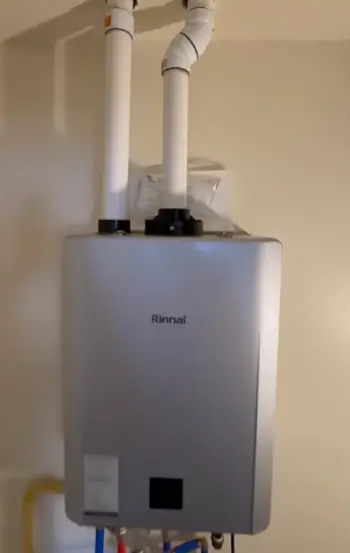
- Efficiency numbers and real energy use: Navien’s NPE-240A2 posts a 0.95 UEF. The Rinnai RX199iN reaches 0.98. On paper Rinnai edges ahead.
In daily use the gap narrows. Both are high-efficiency condensing units. They recover heat from exhaust.
Your actual gas bill depends more on household habits. Climate and recirculation also play big roles.
- Heat exchanger construction: Navien uses dual stainless-steel heat exchangers as standard. Stainless resists corrosion better in hard-water areas.
It supports longer warranty claims. Rinnai has moved toward advanced alloys.
Newer RX models close the old gap. Material choice matters most if your water is hard.
- Recirculation approach: Navien’s A-series includes ComfortFlow technology. It has a built-in buffer tank plus pump.
That cuts the cold-water sandwich effect. Wait times shorten without an external pump. Rinnai offers strong options too.
Many models still need an external pump or return line.
- Noise during operation: Navien units typically run quieter. Family members notice less fan noise. This helps when the heater sits near living spaces.
Rinnai units are not loud by appliance standards. The difference is still audible in a finished basement.
- Brand history and service network: Rinnai has operated longer in the North American market.
It often receives praise for consistent technical support.
Navien grew rapidly as the efficiency leader.
It now holds a large share of condensing sales. Local plumber familiarity can tip the scale.
- Installation flexibility: Both accept PVC venting. Both work on natural gas or propane.
Navien handles smaller gas lines in some setups.
Its dual stainless design helps in tight retrofits. Rinnai’s Smart Sense adjusts to gas conditions.
This helps in areas with variable supply pressure.
- Long-term ownership feel: Owners of both brands report solid results when maintenance is done. Navien often feels more complete out of the box.
Rinnai feels proven and widely supported. Your daily routines decide which difference matters most.
Key Features Of Navien Tankless Units
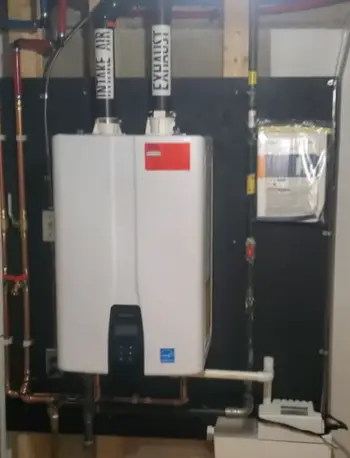
- Dual stainless-steel heat exchangers: These resist scale and corrosion longer than traditional copper.
They work well in many water conditions.
They support the 15-year heat-exchanger coverage. Controlled recirculation keeps the full warranty intact.
- ComfortFlow technology: The built-in pump and small buffer tank keep water ready. Circulating water reduces lag.
First-time tankless owners notice the difference quickly. Distant bathrooms get hot water faster.
- High turndown ratio: Up to 15:1 means the unit modulates down easily.
It handles small draws like hand-washing.
Short-cycling drops. Efficiency stays high during light use.
- Condensing design with high UEF: Most residential models sit at or above 0.95. Nearly all the fuel turns into usable heat.
Exhaust temperatures stay low.
PVC venting remains safe and simple.
- Wi-Fi and app control on many current models: Remote temperature adjustment is handy.
Status alerts help when the unit lives in a garage.
You can check performance without walking downstairs.
- Compact wall-hung footprint: The units free up floor space. A traditional tank no longer takes room.
Indoor or outdoor installation works with the proper kit. Closets and utility rooms stay cleaner.
Easy access service points: Filters and clean-out ports are straightforward. Annual descaling takes less time.
Proper maintenance keeps the unit running longer.
Pros Of Navien
- Integrated recirculation that works out of the box: I appreciated not buying a separate pump. The ComfortFlow system delivered hot water faster. Distant bathrooms felt more convenient. Extra hardware stayed off the shopping list.
- Quiet operation that disappears into the background: Once installed the unit rarely announces itself. Living spaces stay peaceful. This matters more than product pages admit. Shared walls benefit the most.
- Strong corrosion resistance from dual stainless exchangers: Moderate to hard water causes fewer major repairs. Older copper designs needed more attention. Longevity improves with the material choice. Annual care still remains important.
- Competitive long-term efficiency: Real-world gas use stays low. Correct sizing and maintenance matter most. The UEF sits close to the top. Savings accumulate over years of ownership.
- Growing service network and parts availability: More plumbers stock common parts now. Factory training is more common. Diagnosis happens faster in many areas. Support feels more accessible than before.
- Buffer tank reduces temperature swings: The small internal tank smooths delivery. Cold-water sandwich effects drop sharply. Frequent short draws feel more stable. Daily comfort improves.
Cons Of Navien
- Higher purchase price on premium A-series models: Built-in pump and stainless construction cost more. Equipment price sits above some Rinnai options. Installation labor adds to the total. Budget planning needs extra room.
- Sensitivity to water quality and maintenance: Hard-water regions still need annual descaling. Skipped service triggers error codes. Flow can drop over time. Stainless helps but does not remove the need for care.
- Past reports of early control-board or sensor issues: Older generations had more electronic complaints. Current A2 models appear improved. The reputation still lingers in some circles. Choosing a trained installer reduces risk.
- Warranty reductions with uncontrolled recirculation: Continuous external pumps change the terms. Heat-exchanger coverage can drop sharply. Fine print needs careful reading. Controlled setups keep full protection.
- Slight learning curve for first-time owners: Error codes and settings take time to understand. Manuals help but feel dense at first. A good installer walkthrough solves most confusion. Support calls become less frequent later.
Key Features Of Rinnai Tankless Units
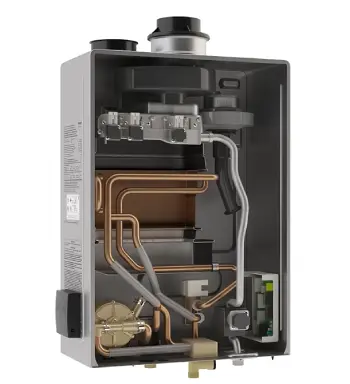
- Industry-leading UEF on the RX series: The RX199iN reaches 0.98.
That ranks among the highest ratings available. Measurable gas savings appear over a decade.
High-use households benefit most.
- Smart Sense gas control: The system adapts to changing gas pressure.
Quality changes cause fewer lockouts. Cold snaps and high-demand periods run smoother.
Manual adjustments become rare.
- Solid maximum flow rates: 11.1 GPM at a 35°F rise covers most family needs.
Simultaneous showers and appliance use stay comfortable.
Proper sizing remains essential for peak demand.
- Flexible indoor or outdoor installation: Many models convert easily.
The right accessories make the switch simple.
Outdoor setups free indoor space. Indoor units stay protected from weather.
- Extended heat-exchanger warranty options: Fifteen years or 12,000 operating hours is standard. Parts coverage lasts five years.
Registration can unlock extra labor protection. Peace of mind grows with the paperwork.
- Broad model range: Smaller units suit apartments.
High-output models handle large homes. Commercial-capable options exist too.
Nearly every household size finds a match.
- Proven combustion systems: Long market presence shows in reliable performance. Variable conditions rarely cause surprises. Owners report consistent hot water delivery.
Pros Of Rinnai
- Excellent efficiency numbers that show on the gas bill: The 0.98 UEF is hard to beat. High-use households see clearer savings. Monthly costs edge lower over time. Peak efficiency feels worthwhile.
- Robust technical support and brand longevity: Long-time owners report smooth service interactions. The company stands behind the product. Confidence grows with the track record. Replacement parts stay available.
- Reliable performance across a wide range of conditions: Smart Sense handles variable gas pressure well. Cold inlet water causes fewer issues. Lockouts become uncommon. Daily operation stays predictable.
- Competitive pricing on comparable high-output models: Recent quotes often favored the RX199iN. Equipment cost landed lower before labor. Value feels strong at the high end. Budget stretches further.
- Straightforward parts and service ecosystem: Independent plumbers know the brand well. Diagnosis feels familiar to many technicians. Repairs move faster in most markets. Experience levels run high.
- Strong simultaneous demand handling: Multiple fixtures run without big temperature drops. Family routines stay uninterrupted. Proper sizing unlocks the full potential. Guests notice the steady supply.
Cons Of Rinnai
- Recirculation often requires extra components: Models without an internal pump need more hardware. External pumps and plumbing raise cost. Complexity increases during installation. Instant hot water takes extra planning.
- Slightly higher operating noise: The difference is not dramatic. It remains noticeable next to a quieter Navien. Utility rooms near bedrooms feel it most. Sound levels stay within normal appliance range.
- Copper heat exchangers on some older or lower-tier models: Those units face more scale risk. Aggressive water can cause pin-hole leaks. Newer RX series avoid most of that concern. Stick to current stainless or advanced-alloy versions.
- Flow ratings that look identical but feel different: Both brands claim roughly 11 GPM. High-demand moments can expose small modulation differences. Recovery speed varies slightly. Real homes reveal the nuance.
- Registration steps for full warranty benefits: Extra labor coverage sometimes needs prompt registration. Missing the window limits protection. Paperwork becomes part of the process. Timely action keeps benefits intact.
Performance And Efficiency Side By Side
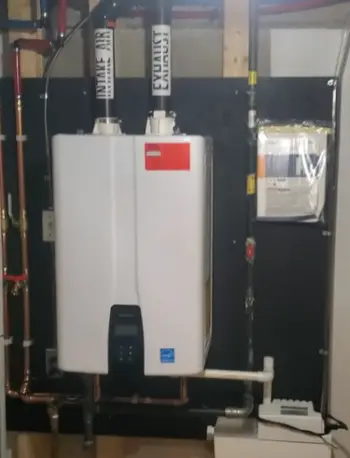
I compared the two under similar conditions.
The home had three bathrooms.
Two adults lived there with occasional guests. Both units supplied two showers and a dishwasher.
Temperature stayed steady when sized correctly.
The Rinnai’s higher UEF produced a small edge in monthly gas use.
The Navien’s buffer tank made hot-water arrival feel more consistent. Distant fixtures improved.
Cold-climate inlet temperatures reduced both units’ effective GPM.
Neither brand overcomes physics.
Proper sizing and professional installation matter more than the brand badge.
These two premium options perform closely once installed well.
Installation And Maintenance Reality Check
Both brands require a licensed professional. The installer must understand gas-line sizing. Venting and condensate drainage need care.
Combustion air matters too. Undersized gas piping causes lockouts on either unit. Annual descaling is non-negotiable in hard-water areas.
Many owners schedule it with regular HVAC service. Navien’s built-in filter and clean-out ports simplify the work. Rinnai units stay equally serviceable with clear access.
Labor warranties are short on both. One year is typical. Choosing an installer who stands behind the work matters greatly. Brand choice alone does not guarantee smooth years of use.
Which Brand Fits Different Households?
If your priority is the absolute highest efficiency rating, choose Rinnai. Strong brand support history also favors it. A slightly lower equipment cost helps too.
The RX series makes a compelling case. If you want integrated recirculation without extra hardware, lean Navien.
Quieter operation and dual stainless construction feel more complete. The NPE-A2 line suits that preference.
Large families with four or more simultaneous fixtures should check local installer experience. Climate, water hardness, and existing plumbing layout also guide the final call. Match the strengths to your daily routines.
Also Read: Comparison Of Bradford White And State Water Heaters
Frequently Asked Questions (FAQ)
Neither wins every category. Navien often feels more convenient. Built-in recirculation and quieter running stand out. Rinnai frequently wins on pure efficiency numbers. Long-term support reputation is strong. Match the strengths to your priorities.
No single brand dominates every home. Navien and Rinnai both rank at the top of the premium segment. The best choice depends on local water conditions. Installer expertise and key features also decide the winner.
Scale buildup from hard water appears often. Occasional error codes relate to flow sensors or ventilation. Reduced performance follows skipped annual maintenance. Proper installation and yearly service prevent most issues.
They perform similarly on flow and capacity. The Navien offers integrated ComfortFlow recirculation. Dual stainless exchangers add durability. The Rinnai posts a higher UEF. Purchase price is often lower. Preference depends on built-in recirculation versus peak efficiency.
Final Thoughts
After living with the research I talked to owners of both brands. Either unit can deliver reliable efficient hot water for many years.
Installation and maintenance must stay correct. You now have the detailed comparison of efficiency features pros and cons.
I wished this existed when I started. Weigh the table carefully. Match the strengths to your daily routines. Choose the installer who shows clear experience with the brand. That combination serves you far better than any single claim.
Whatever you decide the move from a traditional tank feels satisfying. A quality tankless system rewards the effort for years.
Recent Posts
I spent months comparing budget options against established names after my last set of tires wore out sooner than expected.My goal here is to share what I learned from putting Dextero and...
AquaTru Carafe Vs. Classic: Which Is Actually Fits Your Kitchen?
I decided to write this comparison after months of testing both the AquaTru Carafe and the Classic in my own kitchen. Tracking covered daily use.Taste stayed consistent. Refill frequency...