
If you want a salt-free way to reduce hard-water scale without hauling bags of salt, the NuvoH2O water conditioner may look appealing.
But after weighing its technology, cartridge requirements, limitations, and recent customer feedback, I would not recommend buying it without first comparing it with other options.
NuvoH2O can help control scale, but it does not actually remove hardness minerals like a conventional ion-exchange softener.
More importantly, its mixed customer history makes me hesitant to call it the best choice for most households.
My Personal Experience With The Nuvo H2O Water Conditioner
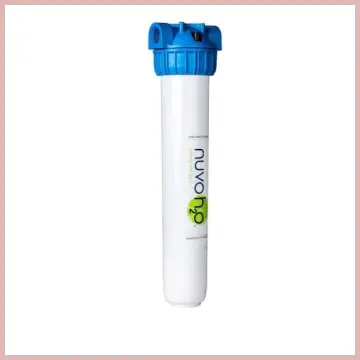
When I first looked at the NuvoH2O system, the concept immediately caught my attention.
I like the idea of treating hard water without salt, regeneration cycles, electrical controls, or a brine tank.
If you have ever carried heavy bags of water-softener salt, you can understand why a compact cartridge-based system sounds attractive.
The first thing I noticed, though, was that the terminology can be confusing.
NuvoH2O is commonly marketed as a “salt-free water softener,” but technically it is better understood as a water conditioner or scale-control system. It does not operate like a conventional ion-exchange softener.
According to the manufacturer, NuvoH2O uses its CitraCharge technology to bind calcium and magnesium so those minerals are less likely to stick to plumbing, fixtures, and appliances.
The company says its process uses citric-based chemistry and retains the minerals in the water rather than replacing them with sodium.
That distinction matters to me.
If my goal were simply to reduce scale inside a water heater or plumbing system, I could see the appeal. But if I wanted genuinely softened water, I would expect the calcium and magnesium hardness to be reduced. A salt-free conditioner doesn’t provide that same result.
This is also something other water-treatment manufacturers acknowledge. SpringWell, for example, explicitly explains that salt-free conditioners do not actually soften water; instead, they condition the hardness minerals so they are less likely to form scale.
I would therefore judge NuvoH2O based on what it is actually designed to do rather than expecting it to behave like a traditional softener.
Another issue that made me cautious was the amount of conflicting customer feedback I found. Some customers report years of satisfactory use and appreciate avoiding salt maintenance.
One ConsumerAffairs reviewer reported using the system for nearly a decade and said their household appliances continued working well without salt maintenance.
But the negative feedback is hard for me to ignore.
ConsumerAffairs currently shows NuvoH2O with a 2.5/5 rating from 55 reviews, with 55% of those reviews rated one star. That’s a substantial warning sign when I am evaluating a relatively expensive whole-house water-treatment purchase.
I also found complaints concerning cartridge condition, system components, and maintenance experiences in online water-treatment discussions.
One Reddit discussion described problems involving a bypass valve and material from a cartridge entering the home’s water system. Those are individual experiences rather than proof that every NuvoH2O installation will fail, but they reinforce my decision to approach the product cautiously.
So, would I call NuvoH2O useless? No.
Would I call it my first choice? Also no.
For me, the biggest problem is that the product occupies an awkward middle ground. It is more sophisticated than a basic filter, but it doesn’t deliver the same type of hardness removal as a true softener. Meanwhile, you still have to buy replacement cartridges.
NuvoH2O says its cartridges gradually dissolve and are generally replaced about every six months. The company’s support information states that the Studio cartridge is rated for up to 20,000 gallons and the Home cartridge for up to 50,000 gallons, although actual lifespan depends on factors such as water use, pressure, and temperature.
That recurring expense changes the calculation.
At first glance, a compact cartridge system may seem cheaper and easier than a traditional softener. But when I consider replacement cartridges over several years, I would want to calculate the total ownership cost before buying.
I also wouldn’t assume that installing NuvoH2O means I can forget about hard-water deposits completely. Salt-free conditioners can reduce scale formation, but they don’t necessarily eliminate the minerals responsible for water spots. Even Aquasana acknowledges that salt-free conditioning can leave calcium deposits on surfaces because the hardness minerals remain in the water.
That’s exactly the kind of distinction I want you to understand before spending money.
If your primary concern is protecting plumbing and appliances from scale, NuvoH2O may have a legitimate use case. If your expectation is noticeably softer-feeling water, less soap usage, dramatically improved lather, and substantially reduced dissolved hardness, I would look at a conventional softener instead.
Pros Of The NuvoH2O Water Conditioner
- No Salt Bags to Carry
The biggest advantage I see is convenience.
NuvoH2O doesn’t require the regular salt handling associated with traditional softeners.
For someone who doesn’t want to store heavy salt bags in a garage or utility room, that’s genuinely attractive.
You also avoid the routine salt replenishment that comes with an ion-exchange system.
- Compact Installation
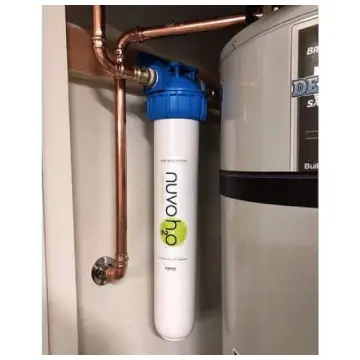
The NuvoH2O design is relatively compact compared with many conventional whole-house softeners.
The company’s Home model, for example, is listed at about 5.67 inches wide and 22.74 inches tall.
That makes a difference if your utility area is cramped.
If I had limited mechanical-room space, I would definitely appreciate a smaller system.
- No Regeneration Cycle
Traditional softeners need regeneration because their resin eventually becomes loaded with hardness minerals. That process can involve water, salt, and a drain connection.
NuvoH2O doesn’t operate that way.
Because the system conditions the minerals instead of capturing them through ion exchange, there is no traditional regeneration cycle.
- Retains Calcium and Magnesium
This could be a positive depending on your preferences.
NuvoH2O says its system retains minerals such as calcium and magnesium rather than replacing them with sodium.
If you specifically want to avoid sodium addition from a traditional softener, this characteristic may appeal to you.
- Can Help With Scale
I wouldn’t dismiss the scale-control concept entirely.
The company says its technology is intended to prevent minerals from bonding to surfaces and also claims to address existing scale.
The important point is that I would interpret this as scale control, not conventional water softening.
- Relatively Simple Cartridge Replacement
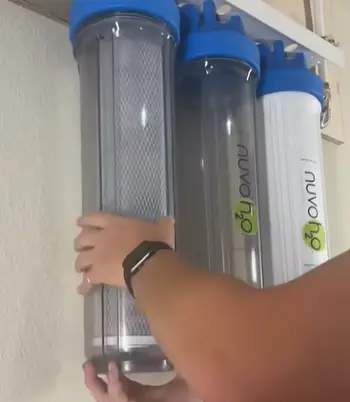
NuvoH2O says cartridge replacement can be completed by bypassing the system, removing the housing, installing the replacement cartridge, and restoring water flow.
That sounds considerably easier to me than managing a conventional brine tank.
Cons Of The NuvoH2O Water Conditioner
- It Does Not Truly Soften Water
This is my biggest criticism.
If you test the water hardness before and after installing a salt-free conditioner, you shouldn’t expect the hardness number to drop dramatically simply because the system is installed.
SpringWell makes this distinction clearly: its salt-free system conditions hardness minerals rather than removing them.
So if your goal is genuine soft water, I would choose an ion-exchange softener.
- Mixed Customer Feedback
This is the second major concern for me.
The current ConsumerAffairs profile shows a 2.5/5 rating across 55 reviews, including a large share of one-star ratings.
There are certainly satisfied customers, so I wouldn’t describe every installation as a failure. However, the negative review volume is significant enough that I would not recommend purchasing NuvoH2O blindly.
- Ongoing Cartridge Expense
The cartridge isn’t a one-time purchase.
NuvoH2O says certain cartridges are designed to last around six months, depending on the model and household conditions.
That means you need to budget for replacement cartridges throughout the life of the system.
For me, this is where the “low maintenance” argument becomes more complicated. You may eliminate salt bags, but you haven’t eliminated recurring maintenance costs.
- It May Not Eliminate Water Spots
This is another expectation problem.
Because the hardness minerals remain in the water, you may still see mineral spots on faucets, glass shower doors, dishes, and countertops.
Aquasana makes the same basic point about salt-free conditioning: scale formation can be inhibited while calcium and other minerals remain present in the water.
Therefore, I wouldn’t buy NuvoH2O expecting spotless glassware.
- Not Ideal for Every Water Condition
Your water chemistry matters.
NuvoH2O’s Home system lists a hardness range of up to 25 grains per gallon and specific operating conditions for pH and water pressure.
If you have unusually hard water or additional contaminants, I would get the water tested before purchasing any conditioner.
- The Warranty Doesn’t Eliminate the Risk
NuvoH2O currently states that its system carries a five-year limited warranty, subject to its terms and installation requirements.
A five-year warranty is useful, but I wouldn’t interpret it as evidence that the system will necessarily be trouble-free for five years.
Maintenance Tips For Novo Water Conditioner
- Replace the Cartridge on Schedule
This is the first thing I would monitor.
NuvoH2O says its cartridges generally last around six months, although the exact lifespan depends on the model and household conditions.
I would mark the replacement date on my calendar rather than waiting until performance becomes questionable.
- Use the Bypass Valve Correctly
Before changing a cartridge, follow the manufacturer’s shutdown and bypass instructions.
I would never force the housing open while the system is under pressure. Relieving pressure first makes cartridge replacement safer and easier.
- Keep the Unit Out of Direct Sunlight
This is particularly important because NuvoH2O’s warranty information says exposure to direct sunlight can void warranty coverage.
So if you’re installing the unit yourself, don’t simply choose the most convenient outdoor location.
- Monitor Water Pressure
The manufacturer specifies operating pressure ranges for its systems. For example, the Home Water Softener page lists an optimal pressure of 45–65 PSI and a maximum of 100 PSI.
I would keep an eye on pressure because excessive pressure can put unnecessary stress on plumbing components.
- Test Your Water Periodically
This is one maintenance step I would recommend regardless of which water treatment system you buy.
Test your water hardness before installation and again afterward.
That gives you a measurable baseline rather than relying entirely on subjective observations such as “the shower feels better.”
If you have well water, I would also consider testing for iron, manganese, sulfur, and other relevant contaminants before selecting a treatment system.
- Clean Fixtures Regularly
Even with a conditioner, don’t expect mineral deposits to disappear completely.
I would continue cleaning faucets, showerheads, glass doors, and sinks regularly.
The goal is to reduce scale—not necessarily eliminate every visible mineral residue.
Comparison Of NuvoH2O With Other Brands
- NuvoH2O vs. SpringWell
SpringWell’s FutureSoft system is another salt-free conditioner, so this is probably the closest comparison.
Both approaches are designed to control scale without conventional salt-based softening. SpringWell uses Template Assisted Crystallization and openly states that its system conditions rather than truly softens water.
Where I become more interested in SpringWell is its larger-capacity system options and lifetime warranty claim.
That doesn’t automatically make SpringWell better, but if I were committed to a salt-free conditioner, I would compare both systems carefully before choosing NuvoH2O.
- NuvoH2O vs. Aquasana
Aquasana is another serious alternative.
Its current salt-free conditioner uses Scale Control Media technology and is designed to inhibit scale rather than remove hardness minerals. The company lists its newer whole-house conditioner as lasting up to 1,000,000 gallons or 10 years and provides a 10-year limited warranty on the current WH-SFWC-S system.
That immediately makes me question whether NuvoH2O’s six-month cartridge replacement model is the most economical choice.
If I wanted salt-free scale protection, I would personally compare the long-term replacement cost of Aquasana against NuvoH2O before spending anything.
- NuvoH2O vs. a Traditional Salt-Based Softener
This is where the difference becomes much more important.
A traditional softener uses ion exchange to remove hardness-causing minerals from the water. Aquasana describes traditional softeners as the conventional approach and notes that they require salt or potassium replenishment and regeneration.
Culligan likewise offers whole-house softeners designed specifically to address hard-water problems, with salt delivery and smart-control options available on some systems.
If I wanted truly soft water, I would choose this category rather than a salt-free conditioner.
Yes, I would have to deal with salt.
Yes, there would be more maintenance.
But I would be choosing the technology specifically designed to reduce water hardness rather than simply controlling scale.
Is NuvoH2O Worth The Money?
For me, this is where the decision becomes straightforward.
If your main objective is avoiding salt, minimizing equipment size, and reducing scale without installing a traditional softener, NuvoH2O can make sense.
But if you’re paying for it because you believe it will transform hard water into genuinely soft water, I think you could be disappointed.
The recurring cartridge requirement also deserves serious attention. A system that looks inexpensive initially can become much more expensive when replacement cartridges are added year after year.
And because current customer feedback is so mixed, I would want to see stronger consistency before recommending it as a first-choice water-treatment system. ConsumerAffairs’ current rating and the negative experiences reported there are enough for me to exercise caution.
Frequently Asked Questions (FAQ)
If by “Novo” you mean NuvoH2O, I would describe it as a water conditioner rather than a true water softener. It is designed to reduce scale formation while leaving calcium and magnesium in the water. If you specifically want hardness minerals removed, I would choose a conventional ion-exchange softener instead.
NuvoH2O can work as a scale-control system, and the manufacturer cites testing supporting its ability to reduce scale formation. However, it does not work like a traditional softener because it does not remove hardness minerals in the same way. Customer experiences are also mixed, so I would not assume identical results in every home.
There isn’t one universal winner because your water chemistry, hardness level, household size, budget, and maintenance preferences all matter. If I wanted a salt-free conditioner, I would compare NuvoH2O with established alternatives such as Aquasana and SpringWell. If I wanted actual hardness reduction, I would look at a conventional ion-exchange softener instead.
NuvoH2O’s system warranty is currently five years, while its cartridges are generally designed to last around six months, depending on the model and usage. The company says the Home cartridge can treat up to 50,000 gallons and the Studio cartridge up to 20,000 gallons. Actual cartridge life can vary with water usage and conditions.
Final Verdict
After considering how the system works, its maintenance requirements, alternatives, and current customer feedback, I wouldn’t make NuvoH2O my first recommendation.
I like the salt-free concept, compact design, and lack of regeneration. I also understand why homeowners want a simpler alternative to traditional softeners. But the distinction between conditioning and actual softening is important, and the recurring cartridge cost adds up. Most importantly, the current review picture is too inconsistent for me to confidently tell you to buy it.
If your only goal is reducing scale without salt, compare NuvoH2O with systems such as Aquasana and SpringWell before deciding. If you want genuinely softened water, I’d spend my money on a properly sized ion-exchange softener instead.
Recent Posts
● Interactive 5-Zone Interior & Exterior Paint Blueprint Paint Coverage Calculator: Gallons, Primer, Square Footage & Cost Tap any architectural surface zone on the blueprint...
If you want smooth, shiny hair without spending a fortune on a premium styling tool, the Ella Bella hair dryer may be worth considering.In these Ella Bella hair dryer reviews, I’ll look...