
If you are considering buying the Tivano Cutting Board, I recommend thinking twice before spending your money.
I understand the appeal of a titanium cutting board that promises easy cleaning, durability, and a more hygienic food-preparation surface.
However, after examining Tivano’s marketing alongside independent complaints and customer experiences, I don’t think it offers enough advantages to justify the risk.
Reports of knife damage, scratching, customer-service problems, and difficult refunds are especially concerning.
For me, a good cutting board should protect my knives, provide dependable food preparation, and offer straightforward ownership—and Tivano raises too many questions in those areas.
My Personal Experience With Tivano Cutting Board
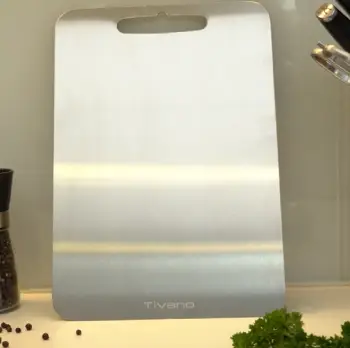
When I first looked at the Tivano Cutting Board, I understood immediately why this product attracts attention.
Traditional cutting boards can become stained, scratched, warped, or smelly after months of cooking.
Tivano takes a completely different approach by using a metal surface and presenting itself as a modern alternative to conventional plastic and wooden boards.
The concept sounds appealing.
I can understand why someone who constantly prepares chicken, fish, garlic, onions, vegetables, and other strongly scented foods would want a surface that does not absorb moisture and odors.
A nonporous material can certainly be convenient because it is easier to wash and dry than some porous surfaces.
Tivano’s own customer-review page contains overwhelmingly positive testimonials, with the page displaying a 4.84/5 rating based on 490 reviews.
Customers featured there praise its cleaning convenience, smooth surface, lightweight construction, dishwasher compatibility, and additional features such as a sharpening section and grating area.
But that is only one part of the picture.
When I assess a kitchen product, I don’t want to look only at the manufacturer’s review page. I want to know what happens when owners encounter problems. That is where my opinion of Tivano becomes considerably more cautious.
One independent consumer complaint page currently shows a 1-star rating based on a registered-user complaint.
The reviewer alleged problems involving an unexpected insurance charge, difficulty canceling the order, a promised refund that reportedly did not arrive, and dissatisfaction with the return process. The same reviewer also claimed the board scratched and damaged knives.
I would not automatically assume that one complaint represents every customer. That would be unfair.
At the same time, I also wouldn’t dismiss it simply because Tivano’s own website displays overwhelmingly positive reviews.
There are other concerns.
An independent 2025 review described the board as functional but less revolutionary than the advertising suggested.
That review praised its resistance to odors and liquids and its ease of cleaning, while also mentioning visible scratches, a somewhat noisy chopping experience, and a price higher than ordinary cutting boards.
That combination is important to me.
A cutting board doesn’t need to be revolutionary. It needs to perform one basic job exceptionally well: give me a stable, food-safe surface that works comfortably with my knives.
And this is where titanium becomes an interesting material choice.
Titanium itself is known for strength, corrosion resistance, and durability. But those qualities don’t automatically mean that a titanium cutting surface is ideal for kitchen knives.
A cutting board can be extremely durable while still being a poor match for a sharp knife edge.
I care about that because my knives are an investment. If I spend good money sharpening a chef’s knife, I don’t want the cutting board to work against it.
I also noticed that Tivano’s own product information advises avoiding extremely hot cookware directly on the board despite describing the board as heat resistant.
That doesn’t make the product bad by itself, but it reminds me that some of the broad marketing language needs to be interpreted carefully.
Another issue is size and handling.
One customer testimonial on Tivano’s review page says the board was smaller than expected.
Another mentioned that the board was thin and that liquid could run onto the counter when cutting foods with a lot of juice. Those comments matter because dimensions and liquid management are practical considerations that aren’t always obvious from advertisements.
So, after weighing the good and bad, my overall impression is mixed at best.
I can see why some people like the board. It has an attractive modern concept, a smooth nonporous surface, and potentially convenient cleaning characteristics.
But would I recommend it?
No.
The potential knife issue is enough to make me hesitate, and the reported customer-service and refund complaints make the purchase less attractive. If I were buying a cutting board today, I would rather choose a well-established wood or food-grade plastic option with a long track record and predictable replacement or return policies.
Pros Of The Tivano Cutting Board
- Easy Cleaning
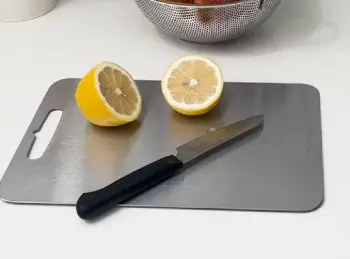
One of the strongest arguments in favor of Tivano is its smooth, nonporous surface.
I can understand the appeal immediately. If I’ve been chopping garlic or raw chicken, I want to clean my board thoroughly without worrying about lingering smells or deep cuts collecting food particles.
Several customers featured on Tivano’s own review page specifically praise how easy the board is to clean.
This is a genuine advantage.
A smooth surface generally makes everyday cleanup straightforward. I don’t have to spend several minutes scrubbing stains out of wood grain or worrying about a plastic board becoming heavily scarred.
For a busy home cook, that convenience can be valuable.
- Resistance to Odors and Stains
Another advantage is the material’s resistance to absorbing food odors and liquids.
If you’ve ever chopped onions on a plastic board and continued smelling onions later, you know exactly why this matters.
Fish can leave a particularly persistent smell. Beetroot can stain surfaces. Garlic can make a board smell long after dinner is finished.
Tivano’s nonporous construction is designed to minimize those problems, and independent reviews have also mentioned the lack of lingering odors and ease of cleaning as positive characteristics.
For me, this is probably the most convincing reason someone might consider the product.
- Modern Appearance
I also understand the aesthetic appeal.
Tivano looks more like a piece of modern kitchen equipment than a conventional wooden chopping board. If you prefer minimalist kitchen products, the sleek metal appearance may be attractive.
It doesn’t have the warm visual character of walnut, maple, or bamboo, but it does look contemporary.
That is subjective, of course.
- Durable Construction
Titanium is a strong and corrosion-resistant material, so I understand why the manufacturer uses that characteristic as a central selling point.
A board that doesn’t warp easily or absorb moisture can potentially last longer than lower-quality plastic boards.
However, I would distinguish material durability from cutting-board suitability. A material can be incredibly durable while still being less suitable for maintaining knife edges.
That distinction is important.
- Additional Features
Depending on the version being sold, Tivano is promoted with additional functions such as sharpening and grating features, liquid grooves, handles, and different preparation zones. Customer feedback on the company’s review page specifically mentions liking these features.
I like multifunctional kitchen equipment when the extra features actually work well.
The problem is that additional features should never distract me from the main purpose of the product.
If I have to choose between a basic cutting board with excellent knife performance and a feature-packed board that potentially damages my knives, I’ll choose the simpler board every time.
- Lightweight Design
Some customer testimonials describe the board as lightweight and easy to store.
That could make a difference in a smaller kitchen.
A cutting board that I can easily move from cabinet to countertop is convenient, especially when I’m cooking several dishes at once.
Still, I would check the exact dimensions before purchasing because at least one customer said the board was smaller than expected.
Cons Of The Tivano Cutting Board
- The Biggest Concern: Knife Performance
This is the issue that bothers me most.
A cutting board should cooperate with my knife.
I don’t want a surface that feels harsh under the blade or contributes to premature dulling. While Tivano marketing and some positive testimonials suggest the board is knife friendly, independent complaints have raised the opposite concern.
The independent consumer complaint I found specifically alleges that the product scratched and damaged knives. Another review also questioned the claim that the board was exceptionally knife friendly.
That contradiction is enough for me to avoid recommending it.
If the product had a minor cosmetic flaw, I could overlook it.
If the board were slightly heavier, I could overlook that too.
But knives are central to food preparation. If a cutting board negatively affects them, I don’t consider that a minor drawback.
- Scratching Can Still Happen
Tivano’s marketing emphasizes durability and resistance to scratching, but independent reports have described scratches appearing during use.
That doesn’t necessarily mean the board will become unusable quickly.
However, I don’t like seeing a gap between promotional expectations and reported ownership experiences.
If I am paying a premium for a supposedly highly durable surface, I expect its real-world performance to match that promise.
- Harder Chopping Experience
Metal is obviously different from wood or plastic.
The tactile experience of chopping on a rigid metal surface can feel less forgiving. One independent review described the chopping experience as somewhat noisy.
Personally, I prefer a board that absorbs at least some of the impact and sound generated during chopping.
If I’m preparing food for several hours, repetitive chopping noise isn’t something I want to add unnecessarily.
- Potential Liquid Management Problems
Some customers have reported that liquid can run off the board and onto the countertop. One testimonial on Tivano’s own review page specifically mentioned this problem when cutting foods with liquid.
This is exactly the sort of practical detail I want to know before buying.
A cutting board isn’t only about the surface.
I also need enough space, sensible edges, good stability, and effective liquid management.
If I’m cutting tomatoes or carving cooked meat, I don’t want juice flowing onto my countertop.
- Price Concerns
Tivano is positioned as a premium product, which means I’m naturally going to compare it with established cutting boards that cost substantially less.
One independent review described the product as more expensive than average and questioned whether the premium was justified.
That’s a reasonable concern.
If the board offered a clear advantage over traditional materials, the higher price could make sense.
But when the product has reports of knife problems and customer-service complaints, paying a premium becomes much harder to justify.
- Customer-Service and Refund Concerns
This is another reason I would personally avoid purchasing Tivano.
An independent consumer complaint alleges difficulty canceling an order, an unexpected insurance charge, failure to receive a promised refund, and a return process involving additional requirements and costs.
One complaint doesn’t prove that every customer will have the same experience.
Still, when I’m buying a relatively simple kitchen product, I want the purchasing process to be straightforward.
If I have to worry about whether I’ll successfully receive a refund if the product isn’t suitable, that affects my buying decision.
Maintenance Tips For Tivano Cutting Board
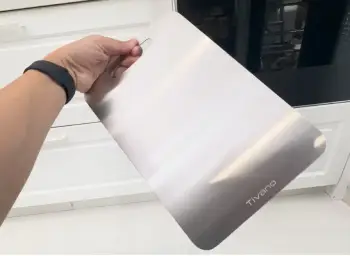
Even though I don’t recommend buying Tivano, anyone who already owns one should still take reasonable care of it.
- Clean It Immediately After Food Preparation
I recommend cleaning any cutting board shortly after use.
Don’t leave raw meat residue sitting on the surface for hours. Don’t allow acidic foods, oils, or sauces to dry onto the board.
A prompt wash makes cleanup easier and reduces the amount of scrubbing required.
- Use Appropriate Dish Soap
For everyday cleaning, a normal dishwashing detergent and clean water should generally be sufficient for removing food residue.
I wouldn’t automatically reach for aggressive chemicals simply because the board is metal.
More aggressive cleaning isn’t always better.
- Dry It Thoroughly
After washing, dry the board completely before storing it.
Although titanium itself has strong corrosion resistance, good kitchen hygiene still means avoiding unnecessary moisture around the board, especially around attached components, feet, grooves, handles, or accessories.
- Avoid Excessively Hot Cookware
Tivano’s own product information advises against putting extremely hot cookware directly onto the board despite describing it as heat resistant.
I would follow that recommendation.
A cutting board isn’t a trivet unless the manufacturer explicitly says it is designed for that purpose.
If I have a boiling-hot skillet, I’ll use a dedicated heat-resistant trivet instead.
- Check the Surface Regularly
I would periodically inspect the board for deep scratches, dents, rough areas, or changes in the surface.
This is particularly important if you’re using sharp knives frequently.
If the board develops significant grooves or damage, I would reconsider continuing to use it.
- Keep the Board Stable
Some customer feedback suggests that the board can be slippery and that its supplied feet or dots help with stability.
I would make sure the board sits securely before cutting.
A sliding board is a safety problem regardless of what material it uses.
If necessary, I would use a suitable nonslip kitchen mat underneath it.
- Avoid Unnecessary Abrasive Scrubbing
If the surface is already easy to clean, there’s no reason to attack it with harsh abrasive pads every day.
Gentler cleaning is generally preferable.
It also lets you monitor how the surface changes over time instead of constantly creating additional abrasion.
Comparison Of Tivano Cutting Board With Other Brands
- Tivano vs Traditional Wooden Cutting Boards
When I compare Tivano with a quality hardwood cutting board, the decision becomes much less obvious.
A good hardwood board has a long history in professional and home kitchens. It can be thick, stable, comfortable to chop on, and aesthetically attractive.
Wood also has a different relationship with knife edges.
For me, that tactile quality matters. I enjoy chopping on a substantial wooden board because it feels stable without feeling harsh.
The downside is maintenance.
Wood generally needs more attention than metal. It needs to be dried properly, and depending on the type and finish, it may benefit from periodic conditioning.
Tivano wins on quick cleanup.
Wood wins for traditional cutting performance and overall kitchen feel.
If knife preservation is my top priority, I’d rather buy a proven hardwood board from an established manufacturer than experiment with Tivano.
- Tivano vs Plastic Cutting Boards
Plastic boards are usually the easiest comparison because they are inexpensive, lightweight, and widely available.
A good food-grade plastic board can be extremely practical.
I can use one for raw meat, wash it thoroughly, and replace it when it becomes excessively scored.
That replaceability is a major advantage.
If I spend a small amount on a plastic board and eventually replace it, I don’t feel as though I’ve made a huge investment.
Tivano potentially offers better resistance to odors and a more rigid construction, but its higher cost and reported knife concerns make plastic a more practical choice for me.
- Tivano vs Bamboo Cutting Boards
Bamboo sits somewhere between traditional wood and modern engineered materials.
It’s attractive, relatively lightweight, and often affordable.
However, bamboo can be harder than some conventional hardwoods, which means I still want to pay attention to knife interaction.
For everyday kitchen use, I would choose a well-made bamboo board from an established brand over Tivano if my primary objective were value.
- Tivano vs Glass Cutting Boards
This is where Tivano looks more appealing.
I generally wouldn’t choose glass as my primary cutting board because hard glass surfaces are notoriously unpleasant for knife edges.
Tivano may offer some benefits compared with glass in terms of design and functionality.
But that doesn’t automatically make Tivano the best choice.
The real question is whether I should choose either one.
For me, the answer is no.
I’d rather use a suitable wood or food-grade plastic cutting board.
Also Read: Is Titan Carve Cutting Board Worth It?
Frequently Asked Questions (FAQ)
There isn’t one universally healthiest cutting board for every kitchen. For me, the most important factors are food-safe construction, a surface that can be thoroughly cleaned, adequate stability, and proper maintenance.
A quality wood cutting board can be an excellent choice when properly maintained. Food-grade plastic can also be practical, especially when it is replaced after becoming heavily scored.
The key is not simply choosing a particular material. I also need to prevent cross-contamination, clean the board after handling raw foods, and replace it when the surface becomes excessively damaged.
I wouldn’t automatically assume that a titanium board is healthier simply because it is nonporous.
The main concerns I would consider are knife compatibility, rigid feel, noise during chopping, price, and the possibility of scratching.
In Tivano’s case, independent reports have specifically raised concerns about scratching and knife damage, while another review described the board as somewhat noisy and more expensive than ordinary alternatives.
Titanium’s strength is a material advantage, but strength alone doesn’t make it an ideal cutting surface.
Gordon Ramsay has been associated with using wooden cutting boards in cooking demonstrations and kitchen settings, although the exact board can vary depending on the program, location, or cookware setup.
I wouldn’t use a celebrity’s choice as the only reason to buy a cutting board. What matters more to me is whether the board suits my knives, cooking habits, cleaning routine, and available counter space.
Titanium cutting boards are not the standard choice I would associate with professional kitchens. Professional cooks commonly rely on established materials such as wood, plastic, and other purpose-built food-preparation surfaces.
That doesn’t mean a titanium board cannot be used in a home kitchen.
It simply means I wouldn’t assume that titanium is automatically better because it sounds more advanced.
For professional-style food preparation, knife performance, stability, sanitation, workflow, and durability all matter.
Final Verdict
After examining the product’s advertised benefits, customer testimonials, independent reviews, and reported complaints, I would not buy the Tivano Cutting Board.
I can appreciate the concept. A nonporous, easy-to-clean cutting surface is appealing, and some customers clearly enjoy the convenience.
But the reported knife-damage concerns, scratching complaints, higher price, and customer-service/refund allegations create too much uncertainty for me.
A cutting board should make cooking easier, not make me worry about my knives or what happens if I need to return the product.
If I were spending my own money, I’d choose a well-established hardwood or quality food-grade plastic cutting board instead.
I would sacrifice some of Tivano’s modern appeal in exchange for something simpler, more proven, and easier for me to trust.
For me, that’s the better deal.
Recent Posts
I tried Meltoway Hair Dissolving Cream because I wanted a quick way to deal with unwanted body hair without reaching for a razor every few days. If you are looking for a convenient at-home...
If you’re considering a saffron-based supplement to support mood, appetite control, and everyday wellness, Happy Saffron Plus is worth considering.I like that it takes a familiar botanical...