
I set out to settle the Tyvek versus Everbilt house wrap debate once and for all after wrapping several projects and watching both materials perform under real job-site conditions.
My goal is simple: help you decide which product better protects your walls from water, air leaks, and trapped moisture without overspending or compromising long-term durability.
| Feature | Tyvek HomeWrap | Everbilt House Wrap |
| Material Type | Non-woven HDPE fibers | Woven polypropylene with coating |
| Vapor Permeability | ~56 US perms | ~11 US perms |
| Water Resistance | Strong holdout (ASTM D779 >60 min range) | Higher rated in some tests (ASTM D779 >90 min) |
| Air Resistance | Excellent (<0.004 cfm/ft²) | Good, meets code as air barrier |
| UV Exposure Limit | Typically 4 months (120 days) | Up to 6 months |
| Tensile Strength | Around 30 lbs/in | Higher (56 MD / 46 CD lbs/in) |
| Tear Resistance | Solid but can snag | Claimed higher for installation ease |
| Price Point | Premium | Budget-friendly |
| Best For | High-breathability climates, mold-prone areas | Cost-conscious builds, shorter exposure windows |
Understanding House Wrap Basics From A Builder’s View
House wrap sits between your sheathing and exterior cladding. It blocks bulk water and wind-driven rain while letting water vapor escape so wall cavities can dry.
Without a solid weather-resistive barrier you risk rot, mold, and higher energy bills from air leakage. I treat this layer as cheap insurance. Skip quality here and the rest of the envelope suffers over time.
Both Tyvek and Everbilt meet code as water-resistive barriers. The differences show up in how they manage vapor, hold up on site, and perform over years of weather cycles.
I have used each on residential frames ranging from simple single-story homes to multi-level custom builds. The choice always comes down to climate, schedule, and budget.
In my experience the material science behind each product creates clear strengths and trade-offs that matter once the siding goes on and the walls are closed up for good.
A house wrap is not just a plastic sheet. It forms part of the continuous drainage plane and air barrier that keeps the structure healthy. Liquid water that sneaks past the cladding must be directed downward and outward. At the same time water vapor that builds up inside from daily living or from damp lumber must be able to leave.
When that balance fails you see staining, soft sheathing, or worse. I have opened walls years later and the condition of the framing told the story of which wrap was chosen and how carefully it was installed.
Key Differences Between Tyvek And Everbilt
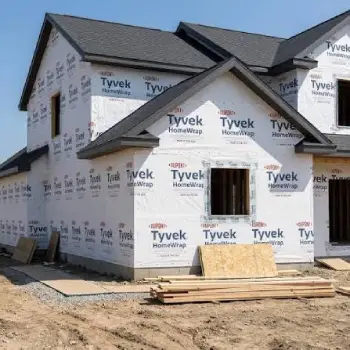
- Material construction sets the performance baseline: Tyvek uses continuous spun high-density polyethylene fibers that form a uniform web with microscopic pores and no punched holes.
Everbilt relies on a woven polypropylene scrim coated on both sides and micro-perforated for vapor movement.
That woven grid feels more fabric-like while Tyvek has a smoother paper-like texture.
- Breathability levels diverge sharply: Tyvek’s higher perm rating lets moisture vapor leave the wall cavity faster. In humid or mixed climates this gives trapped moisture a better escape route.
Everbilt’s lower rating still allows drying but at a slower rate so the difference matters when walls stay closed longer before siding goes on.
- Water holdout and air control trade-offs: Some lab numbers favor Everbilt on pure water resistance tests.
In practice Tyvek’s continuous structure resists bulk water without the weak points that perforations can create.
On air leakage Tyvek consistently edges ahead and fewer drafts appear in windy locations with properly taped seams.
- UV tolerance and job-site timeline: Everbilt gives roughly six months of sun exposure before degradation becomes a concern.
Tyvek’s window is shorter and closer to four months on most ratings. If the siding crew is delayed Everbilt buys extra time yet either product should be covered as soon as possible because prolonged sun weakens any wrap.
- Durability under rough handling: Everbilt’s higher tensile numbers look impressive on paper.
Tyvek can tear around fasteners if crews are careless yet its overall resistance to abrasion often holds up better once installed.
Real-world results show Tyvek surviving high winds with fewer large rips when seams are taped correctly.
Key Features Of Tyvek House Wrap
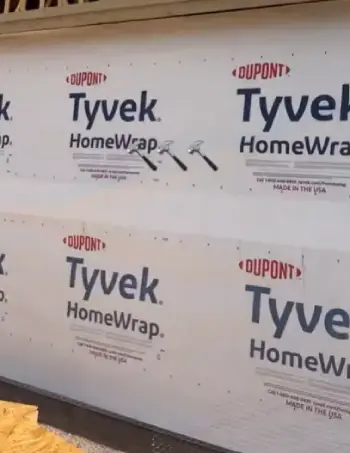
- Continuous non-woven structure: The fiber web creates millions of tiny pores that block liquid water and air while permitting vapor.
No mechanical perforations means fewer weak spots for water to exploit under pressure.
- High vapor transmission: At around 56 perms the material supports rapid drying of wet framing or insulation.
This reduces condensation risk inside walls during seasonal swings.
- Strong air barrier performance: Low air leakage numbers help insulation reach closer to its rated R-value.
Homes feel tighter and HVAC systems work less hard once the envelope is sealed.
- Lightweight and flexible installation: Rolls drape easily around corners and openings.
The surface grips the sheathing somewhat which speeds layout on calm days.
- Proven long-term field history: Decades of use across climates give confidence that the product behaves as advertised when installed with proper overlaps and tape.
Pros Of Tyvek House Wrap
- Superior breathability that actively reduces mold risk: Moisture that enters the wall through windows or cladding has a reliable path out. Walls opened years later often show dry framing where this wrap was used correctly.
- Excellent air sealing that improves comfort and efficiency: Once seams and penetrations are taped the house feels quieter and more consistent in temperature. Utility bills reflect the tighter envelope.
- Consistent water resistance without perforations: The continuous sheet maintains holdout even after minor abrasion. Hydrostatic tests often favor this design over punched-hole alternatives.
- Trusted brand with extensive technical support: Installation guides and compatible tapes are widely available. Clear manufacturer guidance exists for complex details when questions arise.
- Lightweight rolls that speed coverage on large walls: Crews move faster with fewer weight-related complaints. The material conforms well around irregular framing.
Cons Of Tyvek House Wrap
- Higher upfront cost that stretches budgets on large jobs: The premium price adds up quickly on multi-story homes or production runs. Some builders absorb the difference while others look for savings elsewhere.
- Shorter UV exposure window: If weather or labor delays push siding past four months the wrap can begin to degrade. Schedules must be planned tightly when this product is specified.
- Lower tensile strength relative to some woven products: Careless fastening or high winds before siding can create tears that need patching. Proper technique and immediate taping minimize this issue.
- Not surfactant resistant in every test: Certain wood extractives or cleaning agents can reduce water holdout over time. This rarely surfaces on standard residential projects but remains a known limitation.
- Opaque nature that hides underlying sheathing marks: Layout lines and stud locations are harder to see compared with translucent wraps. Experienced crews adapt but beginners sometimes struggle.
Key Features Of Everbilt House Wrap
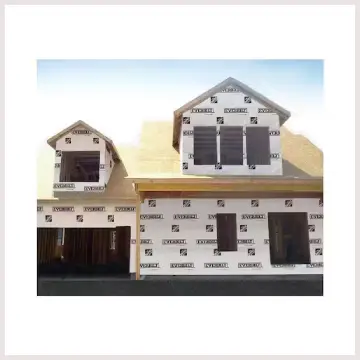
- Woven polypropylene base with dual-side coating: The grid pattern adds strength against tearing during installation.
The coating provides the primary water and air resistance layer.
- Code-compliant water and air barrier: Evaluation reports confirm it meets residential and building code requirements.
Inspectors accept it without extra documentation in most jurisdictions.
- Six-month UV resistance: This longer exposure window helps when framing and wrapping finish ahead of siding crews.
The material can sit uncovered for several months on slower projects without immediate failure.
- Competitive tensile strength: Higher machine-direction and cross-direction numbers make it more forgiving when stapling or nailing through the material.
- Energy-saving air control: By limiting air transfer the wrap supports lower heating and cooling loads.
Product literature highlights this benefit clearly.
Pros Of Everbilt House Wrap
- Attractive price that keeps material budgets in check: For cost-sensitive renovations or speculative builds the savings are real. Entire houses can be completed with this wrap when the client prioritizes other upgrades.
- Longer UV tolerance for flexible schedules: Six months of protection gives breathing room when exterior finishes lag. This alone has saved projects from re-wrapping costs.
- Higher published tensile numbers that resist installation damage: Staples and nails hold with less risk of long rips. Newer crews often prefer the tougher feel during the learning phase.
- Readily available at big-box stores: Same-day pickup avoids special orders. Another roll can be grabbed without waiting when stock runs short.
- Adequate performance for standard residential use: It meets code blocks bulk water and provides measurable air control. Many homes perform well for years with this wrap.
Cons Of Everbilt House Wrap
- Lower vapor permeability that slows wall drying: In high-humidity regions or walls with wet framing the reduced breathability can allow moisture to linger longer. Interior relative humidity needs closer watching on these projects.
- Reliance on micro-perforations for vapor movement: The holes that enable breathability can also create pathways under certain pressure conditions. Lab comparisons sometimes show faster water penetration than continuous-fiber wraps.
- Shorter documented long-term track record: As a house-brand product it lacks the multi-decade field data of Tyvek. Performance claims rest more on testing than extensive published case studies.
- Potential for coating wear under heavy abrasion: Jobsite traffic or rough handling can compromise the water-resistant layer. Once the coating is damaged the woven base offers less protection.
- Variable quality perception among contractors: Some crews report more tears in windy conditions despite the tensile ratings. Consistency from roll to roll can feel less uniform than premium brands.
How I Decide Which Wrap To Specify On A Project?
Climate comes first in my decision process. In mixed-humid or marine zones where walls must dry both inward and outward I favor Tyvek’s higher perm rating.
Cold-climate projects with continuous exterior insulation can succeed with either product if the overall assembly is designed for drying.
Hot-dry regions often tolerate the lower-permeability option without issue because the driving forces for moisture accumulation are lower.
Schedule pressure is the next factor I weigh. Tight timelines with prompt siding favor Tyvek. Extended open-frame periods push me toward Everbilt’s UV advantage.
Budget constraints force a closer look at total installed cost rather than roll price alone. A cheaper wrap that requires more patching or fails early costs more in the end when callbacks and repairs appear.
I also consider the cladding type. Brick veneer or stone with a drainage cavity gives extra forgiveness.
Tight-fitting fiber-cement or vinyl demands better water holdout and air control. In those cases Tyvek’s continuous structure earns the extra spend. Window and door details matter too.
Complex flashing packages benefit from a wrap that holds up well under repeated handling and taping.
Installation quality overrides material choice every time. Both products fail when seams stay untaped, overlaps are reversed, or penetrations go unsealed.
I insist on compatible tape, proper fastening patterns, and a final inspection before cladding covers the wrap.
A well-installed Everbilt outperforms a poorly installed Tyvek in every project I have observed.
Crews that understand the importance of the drainage plane and air barrier produce better results regardless of the brand on the roll.
Frequently Asked Questions (FAQ)
Tyvek wins on breathability and long-term air and moisture control. Everbilt wins on price and UV exposure time. Choose based on climate and budget.
Tyvek is a continuous non-woven HDPE sheet with high vapor permeability. Everbilt is typically a woven coated polypropylene with lower permeability and longer UV rating.
Some specialized high-perm or self-adhered membranes outperform it in specific assemblies but for standard residential use Tyvek remains a top performer. Proper installation often matters more than the brand.
Higher cost, shorter UV window, and lower tensile strength compared with some woven alternatives. It also lacks strong surfactant resistance in certain tests.
Final Thoughts
I have used both Tyvek and Everbilt enough times to respect what each delivers. Tyvek gives me the confidence that walls will dry and air leakage will stay low for decades.
Everbilt lets me stay on budget and finish projects even when schedules stretch. You need to weigh the same factors for your climate, timeline, and wallet.
Measure the risks of trapped moisture against the dollars saved on material. Install either product with care and the house will thank you with fewer problems down the road.
Pick the wrap that matches your priorities and then detail every seam like the performance of the entire building depends on it because it does.
Your walls will stay healthier and your energy bills will stay lower when the weather barrier does its job without interruption for years to come.
Recent Posts
● Interactive 5-Zone Interior & Exterior Paint Blueprint Paint Coverage Calculator: Gallons, Primer, Square Footage & Cost Tap any architectural surface zone on the blueprint...
If you want smooth, shiny hair without spending a fortune on a premium styling tool, the Ella Bella hair dryer may be worth considering.In these Ella Bella hair dryer reviews, I’ll look...