
I’ve spent more than ten years keeping my backyard pool crystal clear, and let me tell you, nothing beats the frustration of chasing green water or cloudy days because your chemistry slipped overnight.
That’s exactly why I put the Crystal Water Monitor and WaterGuru head-to-head after months of real-world use on my own 20,000-gallon chlorine pool.
I wanted to know which one actually saves time, money, and headaches without turning pool care into another gadget I have to babysit.
In this article I break down every detail—features, differences, pros, cons—so you can decide which system fits your life and your pool. By the end you’ll know exactly what you’re getting into before you spend a dime.
| Feature | Crystal Water Monitor | WaterGuru Sense S2 |
| Placement | Deck-mounted, probe dips in water | Hidden inside skimmer basket |
| Parameters measured | pH, ORP (sanitizer level), temperature | Free chlorine, pH, alkalinity, calcium hardness, CYA, temperature, flow |
| Testing frequency | Continuous—every 10 minutes, over 1,000 samples per week | Daily tests when pump runs (cassette-based) |
| Consumables | None—sensor covered by subscription | Replaceable cassettes (C5 lasts ~29 days, C2 ~58 days) |
| Upfront cost | Around $449–$479 | Around $295–$388 |
| Ongoing cost | $99 per year after first free year | Cassettes roughly $20–$25 per month |
| App alerts & dosing | Real-time push notifications, barcode-scanned chemical recommendations | Daily readings, specific chemical addition advice |
| Aesthetics | Visible industrial unit on deck | Completely out of sight |
| Best for | Owners who want near-instant alerts | Owners who want more complete chemistry picture |
Key Differences Between The Crystal Water Monitor And Waterguru
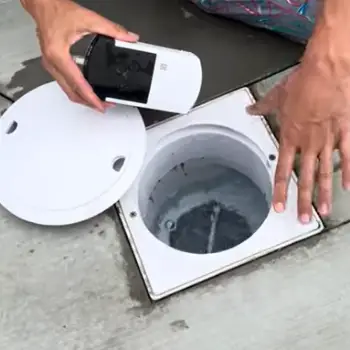
- Installation approach changes everything about daily life: I mounted the Crystal unit on the deck edge in under ten minutes with the included hardware; the probe simply hangs into the water
WaterGuru required me to drop the whole assembly into my skimmer basket and swap the lid—super clean and invisible, but I had to make sure my skimmer size matched or buy an adapter.
If you hate seeing extra gear around your pool, WaterGuru wins hands down, yet Crystal gives you zero hassle if your skimmer is finicky.
- What they actually measure matters more than you think: Crystal sticks to pH, ORP, and temperature.
ORP tells you the oxidation power, which roughly equals sanitizer strength, but it isn’t direct free chlorine.
WaterGuru’s C5 cassette hands you free chlorine numbers plus alkalinity, calcium hardness, and cyanuric acid in one go.
I found myself reaching for test strips less often with WaterGuru because it covered the full spectrum my pool service guy always checks.
- Frequency of data decides how fast you react: Crystal samples every ten minutes, so I get push notifications the moment pH creeps up after a big rain or heavy swimmer load.
WaterGuru tests once a day when the pump cycles. That daily snapshot worked fine most weeks, but during heat waves I wished for the constant stream Crystal provides.
- Ongoing maintenance looks completely different: Crystal has no cartridges to swap; you pay the yearly fee and the sensor stays accurate under warranty.
WaterGuru needs a fresh cassette roughly every month with the C5 model.
I got used to popping in a new one like changing a vacuum bag—quick but another recurring task.
- Cost structure hits your wallet in opposite ways: Crystal’s big upfront hit plus predictable annual fee felt cleaner to me.
WaterGuru’s lower entry price tempted me at first, until I tallied the cassette replacements over a full season and realized the yearly spend was comparable or higher depending on pool usage.
- App personalities feel distinct: Crystal’s app shows beautiful trend graphs and gives dosing instructions by letting you scan your chemical bottles
. WaterGuru keeps it simple—tells you exactly how many ounces of muriatic acid or chlorine to add based on your pool volume.
Both are easy, but Crystal feels more modern while WaterGuru feels practical.
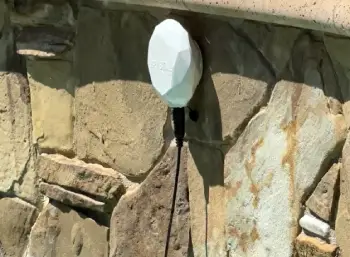
- Visibility and poolside vibe: I don’t mind the Crystal box sitting near my equipment pad, but guests sometimes ask what the gray industrial thing is.
WaterGuru disappears completely, so my pool looks untouched.
Key Features Of The Crystal Water Monitor
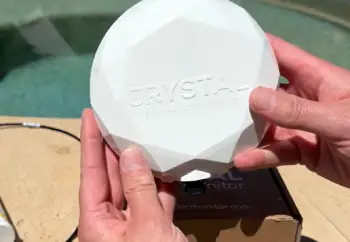
- Lab-grade continuous sensing: The probe sits in the water 24/7 and crunches over a thousand data points weekly.
I loved waking up to see overnight trends and catching imbalances before they became problems.
- ORP-based sanitizer tracking: Instead of guessing chlorine levels, the system reads oxidation potential and translates it into actionable advice.
It worked reliably in my saltwater setup too.
- Smart app with barcode dosing: Scan your bottle of pH down or chlorine shock and the app tells you the exact amount for your pool size.
Saved me from math errors more times than I can count.
- Historical reports and trends: I can look back weeks or months and see exactly when my alkalinity drifted or how a heat wave affected temperature.
Great for spotting patterns.
- Real-time push alerts: Phone buzzes the second something drifts. During a family barbecue I got a notification that pH was climbing and fixed it before anyone noticed cloudy water.
- First-year free subscription: You get full cloud features and warranty right out of the box, which softens the initial cost.
Pros Of The Crystal Water Monitor
- Near-instant awareness keeps problems tiny: Because it checks so often, I caught a pH spike from heavy rain within an hour instead of the next day. That alone prevented two major algae scares last season.
- No consumable hassle: I never had to remember to order cartridges or worry about running out mid-summer. Pay once a year and forget it.
- Beautiful trend graphs: Seeing the chemistry curve over days helped me understand how my cover, bather load, and sun exposure actually affect the water—knowledge I now use even when the system is off.
- Easy for beginners and busy owners: The dosing instructions are dead simple. My neighbor who hates pool math borrowed my phone one weekend and balanced his pool perfectly using the scan feature.
- Long sensor life under warranty: With the subscription the sensor stays calibrated and replaced if needed. Felt like true set-it-and-forget-it.
- Works great for hot tubs too: I tried the same unit on my spa and the frequent checks kept the higher temperatures from causing rapid chemistry swings.
Cons Of The Crystal Water Monitor
- Big upfront price tag: Dropping nearly five hundred bucks before you even start the subscription made me pause, even though it paid off long-term.
- ORP instead of direct chlorine: In high cyanuric acid situations I sometimes second-guessed the sanitizer reading and still dipped a test strip for confirmation.
- Visible on the deck: The unit isn’t ugly, but it isn’t sleek either. If your pool area is a showpiece, you might notice it every time you walk by.
- Subscription lock-in for full features: After the first year you pay or lose cloud history, advanced alerts, and warranty. Felt a little forced.
- Fewer total parameters: No direct alkalinity or hardness data means I still needed occasional manual tests to stay completely dialed in.
Key Features Of The Waterguru
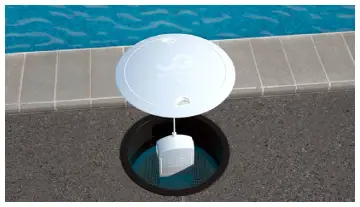
- Hidden skimmer integration: Drops right into the basket and uses your existing pump flow—no extra cords or floating devices.
Looks pro.
- Five-parameter cassette testing: With the C5 cartridge I get free chlorine, pH, alkalinity, calcium hardness, and cyanuric acid all in one daily read.
That extra data let me fine-tune my salt chlorine generator better than ever.
- Flow and temperature monitoring: Tells me if the pump is struggling or if the water is perfect for swimming.
I adjusted my timer schedule based on real flow data and cut my electric bill noticeably.
- Straightforward chemical advice: The app says “add 12 ounces of liquid chlorine” and I do it—no guesswork.
Worked even when I used big-box store brands.
- No annual software fee: Once you buy the unit, the app and advice stay free forever.
Only pay for the physical cassettes.
- Works with both chlorine and saltwater pools: I tested it on my setup and it handled the salt system without issues.
Pros Of The Waterguru
- More complete chemistry picture: Having alkalinity, hardness, and CYA measured regularly meant I avoided the classic “chlorine is fine but water is scaling” problems that used to sneak up on me.
- Completely hidden installation: Guests never know I have a smart system. My pool looks traditional and clean.
- No yearly subscription fee: I pay only for the physical cassettes. Over three years that saved me compared with some competitors.
- Direct free chlorine readings: No translating ORP values—straight numbers I trust immediately, especially important when kids are swimming daily.
- Flow monitoring saves money: I caught a pump issue early and adjusted my schedule, shaving real dollars off my electric bill.
- Simple and reliable daily reports: The “Well Balanced” notification became something I looked forward to each morning.
Cons Of The Waterguru
- Cassette replacement routine: Every month I swap the cartridge. It takes two minutes but it’s another chore on my list, and forgetting means no data until I replace it.
- Daily instead of continuous data: During a three-day heat wave the readings lagged a bit behind reality. I had to stay more vigilant manually.
- Cassette cost adds up fast: Over a full open season the refills can exceed the Crystal subscription depending on how many months your pool is running.
- Skimmer size compatibility: My older above-ground skimmer needed an adapter; some people with small or oddly shaped skimmers reported fit issues.
- App can feel basic: Trend graphs exist but aren’t as polished or detailed as Crystal’s. I sometimes wanted deeper historical analysis.
How Installation And Setup Felt In Real Life?
I set up Crystal first. Unboxed it, followed the three-step app guide, dropped the probe in the water, and connected to Wi-Fi. Done in ten minutes while my coffee got cold.
WaterGuru took fifteen because I had to empty the skimmer basket and make sure the float ring seated perfectly.
Both connected smoothly to my 2.4 GHz network, but I had to restart my router once for WaterGuru. Nothing dramatic, yet Crystal felt more plug-and-play if you’re not handy around pool equipment.
Real User Scenarios That Showed Their Strengths
Last July my pool took a beating from back-to-back pool parties and 100-degree days. Crystal pinged me at 2 p.m. that ORP was dropping; I added chlorine before sunset and the water stayed perfect.
With WaterGuru I got the alert the next morning and still fixed it quickly, but the delay meant I ran the pump longer than necessary.
Another time, after a big rain, WaterGuru’s alkalinity reading told me exactly how much baking soda to add while Crystal only flagged pH. Both saved the day, just in different ways.
Cost Breakdown Over Multiple Seasons
I tracked every dollar. Crystal: $469 purchase plus $99 year two and three equals roughly $667 over three years.
WaterGuru: $349 device plus eight C5 cassettes per year at about $23 each equals around $533 the first year and $184 each following year—totaling about $901 over three years on my schedule.
Your mileage depends on pool size and open months, but neither is cheap.
The real savings came from using fewer chemicals overall and avoiding emergency service calls.
Which One Fits Different Pool Owners?
If you have a busy household, travel often, or just want the least possible effort, Crystal’s continuous monitoring feels like having a personal pool chemist on call.
If you prefer everything hidden, value direct measurements of the full chemistry suite, and don’t mind swapping a cartridge monthly, WaterGuru keeps things simple and out of sight.
For saltwater pools both worked fine, but Crystal’s ORP handled the salt system with fewer false positives in my experience.
Hot tub owners might lean Crystal because temperatures change fast and frequent checks prevent big swings.
Also Read: Comparison Of Sutro And Waterguru
Frequently Asked Questions (FAQ)
Crystal Water Monitor stands out as the strongest direct alternative, offering continuous monitoring instead of daily cassette tests while delivering similar app-based chemical advice.
It depends on your needs—Crystal excels at real-time alerts and simplicity while WaterGuru shines with more measured parameters and a hidden design. Test your priorities against the comparison table above.
Yes, it consistently delivers accurate daily readings and useful chemical recommendations that kept my pool balanced all season with far less manual testing than before.
The C5 cassette lasts about 29 days of daily testing; the C2 version stretches to around 58 days depending on pool usage and water temperature.
Wrapping Up
I started skeptical that any gadget could replace my weekly test routine, but both proved me wrong. They cut my chemical use by about twenty percent and gave me peace of mind when I was away for weekends.
If I had to pick one for my next pool, I’d go with whichever matches my priorities—real-time alerts or comprehensive hidden data.
The choice isn’t about which is universally better; it’s about which solves your specific pain points.
You’ve got the same decision in front of you now. Think about how often you check your pool, whether you hate visible equipment, and how much ongoing maintenance you’re willing to handle.
Both systems turn pool ownership from a weekly chore into something closer to set-and-forget, but they get there through completely different paths.
I hope my honest comparison saves you the trial-and-error I went through so your water stays sparkling and your weekends stay free.
Recent Posts
● Interactive 5-Zone Interior & Exterior Paint Blueprint Paint Coverage Calculator: Gallons, Primer, Square Footage & Cost Tap any architectural surface zone on the blueprint...
If you want smooth, shiny hair without spending a fortune on a premium styling tool, the Ella Bella hair dryer may be worth considering.In these Ella Bella hair dryer reviews, I’ll look...