
I spent weeks living with both the Echo Dot and the Echo Dot Max side by side in my apartment, testing them for music, smart-home control, voice accuracy, and everyday convenience.
My goal here is simple: help you decide which one actually fits your space, budget, and habits without the usual marketing noise. After daily use across different rooms and routines, the differences became clear enough that I can walk you through them honestly.
| Feature | Echo Dot (5th Gen) | Echo Dot Max |
| Price (approx.) | $50 | $100 |
| Speaker system | Single 1.73-inch driver | 0.8-inch tweeter + 2.5-inch woofer |
| Bass claim | Standard | Nearly 3x the Dot |
| Processor | AZ2 Neural Edge | AZ3 |
| Wi-Fi | Dual-band | Wi-Fi 6E |
| Smart-home hub | Limited (Matter bridge) | Full (Zigbee, Thread, Matter) |
| Dimensions | ~3.9 x 3.9 x 3.5 in | ~4.27 x 4.27 x 3.9 in |
| Weight | ~11 oz | ~18 oz |
| Colors | Charcoal, Glacier White, Deep Sea Blue | Graphite, Glacier White, Amethyst |
| Sensors | Temperature, motion | Temperature, ambient light, presence, more advanced |
| Audio inputs | None | None |
| Best for | Budget, small rooms, basic use | Better sound, full hub duties |
Key Differences Between The Echo Dot Max And Echo Dot
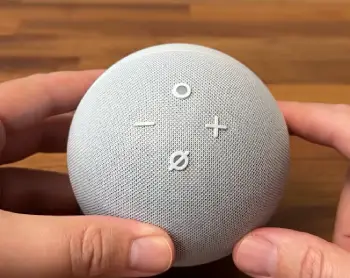
- Size and footprint: The Max sits a little taller and wider than the regular model. On a nightstand the difference is noticeable but not bulky.
The regular Dot still feels more pocket-sized and easier to tuck into tight corners without drawing attention.
- Audio architecture: The Dot relies on one full-range driver that handles everything.
The Max adds a dedicated tweeter and larger woofer which changes how music and podcasts land in the room.
Bass has more weight and highs stay clearer when you push the volume higher.
- Processing power: The newer AZ3 chip in the Max handles voice detection faster and filters background noise more effectively.
I noticed fewer missed wake words when the TV was on or water was running in the kitchen during testing.
- Connectivity and hub capability: The Max supports Wi-Fi 6E and acts as a proper Thread border router plus Zigbee hub for many devices.
The Dot stays on dual-band Wi-Fi and offers more limited Matter bridging so you may still need extra hardware for some setups.
- Design details: Controls and the light ring sit on the front face of the Max making them easier to see and press from across a desk.
The fabric finish looks a bit more refined and the purple option stands out if you want something less generic in your space.
- Price gap: You pay roughly double for the Max compared to the standard Dot.
That extra money buys measurable sound improvement and stronger smart-home features but it is still a compact mono speaker rather than a full stereo system.
Key Features Of The Echo Dot
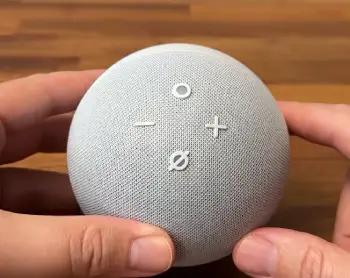
- Compact spherical design that fits almost anywhere: It sits comfortably on a bookshelf bathroom shelf or kitchen counter without dominating the surface.
The light ring on the bottom is subtle once you get used to seeing it in daily use.
- Temperature and motion sensors: These let you build simple routines that feel natural over time.
Walk into the room and lights can turn on or the speaker can report the current temperature without you asking every single time.
- Tap gestures: A quick tap on top pauses music snoozes an alarm or ends a call.
It feels natural after a day or two of practice and becomes second nature for quick interactions.
- Eero Built-in support: If you already run an Eero mesh network the Dot can act as an extra node and add coverage to weaker areas.
Speeds are modest but it is useful for filling small dead spots around the home.
- Solid everyday Alexa performance: Alarms timers weather shopping lists and basic smart-home commands work reliably for most people.
Voice recognition is good enough for typical households once you train Voice ID properly.
- Affordable entry point: At roughly half the price of the Max it remains the easiest way to add Alexa to another room without overspending on features you may not need yet.
Pros Of The Echo Dot
- Excellent value for basic needs: You get reliable voice control decent sound for the size and useful sensors without spending much money. For a secondary room or a first smart speaker it still makes complete sense for most users.
- Small and unobtrusive: It disappears into most spaces without looking out of place. If you already own several Dots adding another keeps the look consistent across different rooms.
- Proven track record: The fifth-generation model has been refined over years of software updates from Amazon. Most quirks people complained about in earlier versions are gone in this one.
- Easy to place and move: Light weight and compact shape mean you can shift it from nightstand to desk without thinking twice about the effort involved.
- Good enough sound for casual listening: Podcasts news and background music sound clear in everyday situations. You will not mistake it for a hi-fi system but it never feels inadequate for typical daily use.
Cons Of The Echo Dot
- Limited bass and volume headroom: Push it past medium volume in a larger room and the sound thins out quickly. Music lovers notice the ceiling on performance quite fast during longer sessions.
- Weaker smart-home hub role: You may still need an extra bridge for certain Zigbee or Thread devices in your collection. That adds cost and another box that needs power and network access.
- Older wireless standard: Dual-band Wi-Fi works fine in most homes for streaming and control. It lacks the future-proofing of Wi-Fi 6E when the network gets crowded with many active devices.
- Less refined voice pickup in noisy environments: It still works for most commands yet the Max clearly hears better when the dishwasher is running or kids are talking over each other nearby.
Key Features Of The Echo Dot Max

- Two-way speaker system with dedicated woofer and tweeter: This is the first Dot-style device to separate the drivers for better performance.
Music has clearer separation and bass reaches lower without sounding forced at moderate listening volumes.
- AZ3 processor and improved microphone array: Amazon claims better conversation detection with this setup.
In practice the Max picks up quieter speech and handles overlapping voices more cleanly than the regular Dot during busy moments.
- Full smart-home hub: Zigbee Thread and Matter support means many lights sensors and locks can connect directly to the device.
You can skip buying a separate bridge for a lot of common smart-home devices in your setup.
- Wi-Fi 6E and stronger wireless options: Streaming stays more stable when the network is busy with multiple devices active.
The device can also help extend an Eero network for better overall coverage.
- Refined front-facing controls and light ring: Volume mute and the expressive LED sit where you can actually see them from normal angles.
The muted state uses a small red indicator instead of a bright ring that used to feel intrusive.
- Presence and ambient sensing: Extra sensors help the device understand when someone is in the room more accurately.
This can feed more natural routines once advanced features become fully available in your area.
Pros Of The Echo Dot Max
- Noticeably better audio for the size: The dual-driver setup delivers fuller bass and clearer highs in real rooms. Playlists sound more enjoyable and spoken content stays intelligible even when you step into the next room.
- Genuine smart-home hub capability: Connecting lights sensors and locks becomes simpler with direct support. Fewer extra bridges mean fewer points of failure and less overall clutter in your setup.
- Faster and more accurate voice responses: The AZ3 chip and improved mics reduce the number of missed commands. Conversations feel smoother once advanced features are active on the device.
- Modern design and better physical controls: The front-facing layout is more practical for daily interactions. The fabric finish looks intentional rather than purely functional and the color options include a distinctive purple shade.
- Stronger wireless foundation: Wi-Fi 6E keeps streaming and multi-room audio more stable under load. The device also plays nicely with existing Eero networks for expanded coverage.
Cons Of The Echo Dot Max
- Higher price for what is still a compact mono speaker: Double the cost of the regular Dot is a real consideration for many budgets. If you only need basic commands and occasional music the extra money may feel hard to justify fully.
- Still no stereo pairing within a single unit: Like the Dot it is mono by design. You need two units or an external speaker if you want true left-right separation for music.
- No battery or wired audio jack: It must stay plugged in at all times for power. You cannot feed it audio through a cable so everything stays wireless by necessity.
- Slightly larger footprint: The size increase is modest compared to the regular Dot. Yet it is less able to disappear into the background in very tight spaces around the home.
Real-World Listening And Daily Use

I kept the regular Dot in the bedroom and the Max in the living room for several weeks of testing.
Morning alarms and weather checks felt identical on both devices. The difference appeared when I played music while cooking or when I asked questions over the noise of a running fan.
The Max filled the open space more convincingly and rarely needed a second command from me.
Voice detection stayed sharp even when I spoke from the kitchen while the Max sat on the coffee table across the room.
For pure smart-home control the Max pulled ahead in convenience. I connected several Zigbee bulbs and a Thread sensor directly without hunting for a separate hub device.
Routines triggered more reliably once presence sensing joined the mix of available tools. The Dot handled the same lights through a bridge but the extra step was noticeable during the initial setup process.
Neither device replaces a proper stereo system in a dedicated listening space. Both remain mono smart speakers first and foremost.
If your main use is voice commands timers and light control the regular Dot still does the job well for most people.
If you also want music that feels more present and a cleaner smart-home backbone the Max earns its keep over time.
Which One Fits Different Situations?
If you are equipping multiple rooms on a budget start with several regular Dots across the home.
The savings add up quickly and the performance is consistent enough that most people never feel limited by the choice.
Place the Max in the main living area where better sound and stronger hub features matter most for daily life. That combination gives you coverage and quality without overspending everywhere at once.
For a single-device household the choice is more personal and depends on priorities.
Do you care about bass and future-proof connectivity or do you mainly want Alexa to answer questions and control a few lights?
The answer usually decides it after a bit of honest reflection on your habits.
Also Read: Comparison Of Amazon Echo And Echo Dot
Frequently Asked Questions (FAQ)
Some users feel responses have become more promotional privacy settings changed and newer generative AI tools make older voice assistants feel limited. Others simply lose interest after the novelty fades over months of use.
Yes if you want better sound and a full smart-home hub in one compact package. No if you only need basic voice control and already own a solid Dot that meets your needs.
The Max is better for audio quality and smart-home expansion in most cases. The regular Dot is better for price and pure simplicity when those factors matter more.
No. The fifth-generation Dot remains in the lineup alongside the newer Max for different buyer needs.
Final Thoughts
After living with both I keep the Max in the room where I spend the most time and rely on regular Dots elsewhere in the apartment.
The sound improvement and hub features on the Max make daily life smoother overall. Yet the cheaper Dot still feels like the smart choice for secondary spaces where advanced features are less critical.
You should weigh how much you value music quality and device consolidation against the extra cost involved.
Once you decide what matters most in your home the right pick becomes obvious quite quickly.
Pick the one that matches your actual habits rather than the one that looks more impressive on paper and you will end up happier with the final setup.
Recent Posts
● Interactive 5-Zone Interior & Exterior Paint Blueprint Paint Coverage Calculator: Gallons, Primer, Square Footage & Cost Tap any architectural surface zone on the blueprint...
If you want smooth, shiny hair without spending a fortune on a premium styling tool, the Ella Bella hair dryer may be worth considering.In these Ella Bella hair dryer reviews, I’ll look...