
I’ve spent years testing enameled cast iron in my own kitchen, and the choice between the Le Creuset Everyday Pan and the Braiser keeps coming up whenever friends ask what piece actually earns its keep day after day.
My goal here is to help you decide which one fits the way you really cook, so you walk away knowing exactly which vessel will stay on your stove most often.
| Feature | Le Creuset Everyday Pan | Le Creuset Braiser |
| Material | Enameled cast iron | Enameled cast iron |
| Typical Capacity | 3–3.5 qt (11-inch) | 1.5–5 qt (most popular 3.5 qt) |
| Interior Finish | Black satin enamel | Light-colored enamel (most sizes) |
| Lid | Not included (glass lid sold separately) | Tight-fitting cast-iron lid included |
| Shape | Wide surface, slightly curved sides, moderate depth | Wide base, shallow sloped sides |
| Weight | Lighter for cast iron | Heavier, especially with lid |
| Best For | Daily searing, sautéing, one-pan meals | Braising, slow simmering, covered oven work |
| Oven Safe | Up to 500°F | Up to 500°F |
| Dishwasher Safe | Yes (hand wash preferred) | Yes (hand wash preferred) |
| Warranty | Limited lifetime | Limited lifetime |
What Makes Each Pan Distinct?
When I first unboxed the Everyday Pan I expected another pretty enameled piece that would mostly sit on a shelf.
Instead it became the pan I reach for on weeknights. The Braiser, on the other hand, is the one I pull out when I want something that spends serious time in the oven or needs moisture locked in.
Both are made in France from the same high-quality enameled cast iron, both handle induction, gas, electric, and the oven without complaint, and both carry the brand’s lifetime warranty. The real differences show up the moment you start cooking.
Key Differences Between The Le Creuset Everyday Pan And Braiser
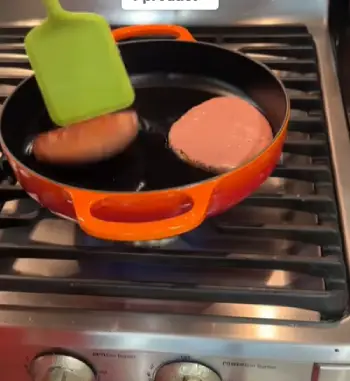
- Shape and depth: The Everyday Pan sits between a skillet and a shallow casserole with sides high enough to hold sauces yet low enough for easy flipping and quick reduction. The Braiser offers a broader base and gentler slope that encourages steady evaporation during longer cooks.
- Lid situation: The Braiser arrives with a heavy domed cast-iron lid that creates a self-basting environment where condensation returns to the food.
The Everyday Pan ships without a lid so you must buy a glass one separately or improvise if you need covered cooking.
- Interior enamel: The Everyday Pan uses black satin enamel that builds a natural patina over time and helps develop fond.
Most Braiser sizes feature the classic light sand enamel that lets you clearly watch browning progress and judge the right moment for deglazing.
- Weight and handling: The Everyday Pan feels noticeably easier to lift and move even when full.
The Braiser with its lid carries more mass that holds steady heat for hours yet demands solid mitts and a firm grip when transferring from stove to oven.
- Capacity options: The Everyday Pan centers on the practical 11-inch size that serves two to four people well.
The Braiser line stretches from compact 1.5-quart versions up to generous 5-quart models so you can match capacity more precisely to the meal.
Key Features Of The Le Creuset Everyday Pan
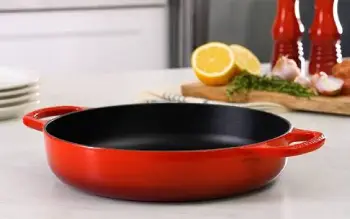
- Wide cooking surface with moderate depth: You can sear six chicken thighs or a full load of vegetables without stacking them.
The depth still contains sauces while keeping most stovetop splatters under control during active cooking.
- Slightly curved sides: Stirring, flipping, and scraping become smoother because there are no sharp corners where sauce can hide and burn.
This makes cleanup and sauce reduction far more pleasant.
- Black satin interior: It starts ready to use with no seasoning required and gradually becomes more nonstick as the patina develops.
Eggs and delicate fish release cleanly after regular use.
- Oversized loop handles: They stay cooler longer than thin handles and give you a secure two-handed grip when the pan is hot and full.
This makes the move from stove to oven or table feel safer.
- All-cooktop and oven compatibility: It works on induction, gas, electric, and ceramic surfaces and goes into the oven up to 500°F.
Finishing under the broiler or completing a one-pan meal is never a problem.
- Relatively lighter weight for its class: Compared with many other enameled cast-iron pieces of similar capacity, this one feels more manageable for daily use.
It reduces the strain of frequent lifting.
Pros Of The Le Creuset Everyday Pan
- True everyday versatility: I use mine for searing steaks, frying eggs, simmering tomato sauce, roasting cauliflower, baking skillet cornbread, and even deep-dish pizza. One pan covers the majority of weeknight cooking needs.
- Faster response to heat changes: Because it is lighter and more open it reacts more quickly when you adjust the burner. This helps when moving from a high-heat sear to a gentle simmer in the same vessel.
- Easier to store and handle: It takes less cabinet space than a full Braiser with lid and can often be moved one-handed. This makes it more practical for smaller kitchens or frequent daily use.
- Develops a useful patina: The black interior becomes more nonstick with regular cooking. This is a quiet long-term benefit that improves performance over months of use.
- Attractive price relative to other Le Creuset pieces: It costs less than a comparable Braiser while still delivering the brand’s heat performance and wide color range.
- Serves as an elegant oven-to-table dish: The exterior colors look intentional on the table and the pan holds heat well enough that second helpings stay warm throughout the meal.
Cons Of The Le Creuset Everyday Pan
- No lid included: If you want to steam, braise, or lock in moisture you must buy a lid separately or improvise. This adds both cost and another item to store.
- Limited size options: The main size works well for two to four people but can feel too small for big-batch cooking or oversized for frequent solo meals.
- Less ideal for long covered braises: Without the tight lid and deeper moisture-trapping design, extended slow cooking requires more attention or a different vessel.
- Handles still get hot: Like all cast iron the handles transfer heat quickly. Silicone grips or good mitts remain necessary for safe handling.
- Investment pricing: Even though it is more approachable than some Le Creuset pieces it remains a premium purchase compared with basic nonstick or stainless pans.
Key Features Of The Le Creuset Braiser

- Broad base and shallow sloped sides: Maximum contact with the heat source delivers fast even searing.
The gentle slope then supports steady simmering once liquid is added for classic braising results.
- Domed cast-iron lid: It creates the classic self-basting environment that keeps food moist over long cooking times.
This reduces the need for constant basting or checking.
- Light enamel interior: You can see exactly how brown the fond is becoming and whether the sauce needs further reduction.
This gives better control during the critical browning stage.
- Generous size range: Options from personal 1.5-quart pieces to family-sized 5-quart versions let you choose the capacity that matches how many people you usually feed.
- Excellent heat retention: Once the Braiser reaches temperature it stays hot for extended periods.
This is ideal for long low oven sessions or keeping food warm at the table.
- Signature loop handles and sturdy construction: The design allows safe movement from stovetop to oven to table without flex or wobble even when the vessel is fully loaded.
Pros Of The Le Creuset Braiser
- Purpose-built for braising: The combination of wide base and tight lid produces reliably tender meat and concentrated sauces with less babysitting during long cooks.
- Superior moisture control: The domed lid creates a self-basting effect that keeps food juicy over extended cooking times. This reduces the need for frequent basting.
- Excellent for oven work: Roasting chicken, finishing stews, or baking casseroles feels natural because the vessel was designed for the stove-to-oven transition.
- Multiple size choices: You can select the exact capacity that matches the number of people you usually feed, from small personal portions to larger family meals.
- Beautiful serving piece: It looks intentional on the table and holds heat well enough that second helpings stay warm without extra effort.
- Versatile beyond pure braising: Shallow frying, searing, simmering, and even baking certain desserts all work well in the same vessel.
Cons Of The Le Creuset Braiser
- Heavier overall: When full of food and wearing its lid the Braiser demands more strength and careful handling. This is especially true when it is hot from the oven.
- Takes more storage space: The lid adds bulk and the wider profile needs a wider shelf or drawer. This can be inconvenient in compact kitchens.
- Higher price point: You pay for the specialized design and the included lid. The entry cost sits higher than the Everyday Pan.
- Light interior can show marks: While the enamel is durable, the sand-colored surface reveals staining and discoloration more readily than the black satin of the Everyday Pan.
Overkill for simple weeknight tasks: If most of your cooking involves quick sears and sautéed vegetables the Braiser’s strengths go unused. The extra weight becomes a daily inconvenience.
How I Actually Use Them In Real Life?
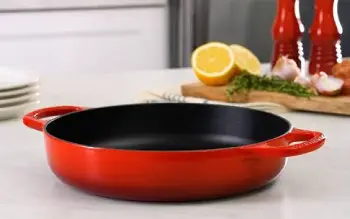
On a typical Tuesday I grab the Everyday Pan. Chicken thighs go in skin-side down, vegetables get tossed in the rendered fat, a quick pan sauce comes together, and dinner is on the table with only one pan to wash.
The open surface lets moisture escape so the skin stays crisp and the sauce reduces naturally.
When the weekend arrives and I want short ribs or a whole chicken with root vegetables, the Braiser comes out.
I sear in batches if needed, add aromatics and liquid, clamp on the lid, and slide the whole thing into a moderate oven.
Hours later the meat falls apart and the sauce has deepened without me hovering. The lid does the work.
Both pans clean easily with warm water, a soft sponge, and a bit of dish soap. I avoid metal utensils to protect the enamel and never plunge a hot pan into cold water.
Hand washing keeps the exterior looking new longer, though both are technically dishwasher-safe.
Who Should Choose The Everyday Pan ?
If your cooking leans toward weeknight speed, one-pan meals, searing, frying, and dishes that benefit from evaporation rather than moisture trapping, the Everyday Pan will earn its keep faster.
Smaller households, limited storage, or anyone who wants a single high-quality vessel that replaces several lesser pans will appreciate it most.
The black interior and lighter weight make daily use feel less like a commitment.
Who Should Choose The Braiser?
If you regularly braise, slow-cook tougher cuts, make stews that spend time covered, or love the idea of a vessel that moves from stove to oven to table without fuss, the Braiser is the stronger match.
Larger families or anyone who values the self-basting lid will find the extra weight and cost worthwhile. The size range also lets you buy exactly the capacity you need.
My Personal Take After Extended Use
I own both. The Everyday Pan sees more weekly action because it matches how I cook most of the time.
The Braiser is the specialist I pull out when the recipe demands it. If I could keep only one, the Everyday Pan would stay because versatility wins in a real kitchen.
That said, once you experience proper braising with the dedicated lid, it is hard to go back to improvised covers.
The honest answer depends on the meals you actually make, not the meals you imagine making.
Price is real. Both pieces represent an investment. Yet the lifetime warranty and the way enameled cast iron holds up mean you are unlikely to replace them.
I still use pieces that are more than a decade old and look nearly new with basic care.
Also Read: Comparison Of Victoria Cast Iron And Lodge
Frequently Asked Questions (FAQ)
Yes if you want one versatile enameled cast-iron pan for daily searing, sautéing, and one-pan meals. It replaces multiple lesser pans for many cooks.
Searing meats, sautéing vegetables, simmering sauces, frying, roasting, baking skillet dishes, and finishing under the broiler.
The tight-fitting lid traps moisture and creates a self-basting environment ideal for long, gentle cooking of tougher cuts and stews.
The high price and the weight of the pieces. Both require careful handling of the enamel and a willingness to invest upfront.
Final Thoughts
I started this comparison wanting a clear winner, and I ended up with two tools that simply serve different moments.
The Everyday Pan makes weeknight cooking smoother and more enjoyable. The Braiser turns slow-cooked meals into something special with less effort.
Look at the meals you cook most often, the space you have, and how much you value a lid that stays on for hours.
Then choose the one that will actually get used. Either way you end up with cookware that performs beautifully and lasts for years. That is the real payoff.
Recent Posts
I tried Meltoway Hair Dissolving Cream because I wanted a quick way to deal with unwanted body hair without reaching for a razor every few days. If you are looking for a convenient at-home...
If you’re considering a saffron-based supplement to support mood, appetite control, and everyday wellness, Happy Saffron Plus is worth considering.I like that it takes a familiar botanical...